The European Gaze on India 1519 – 1946 About

← Antiquity and Renaissance

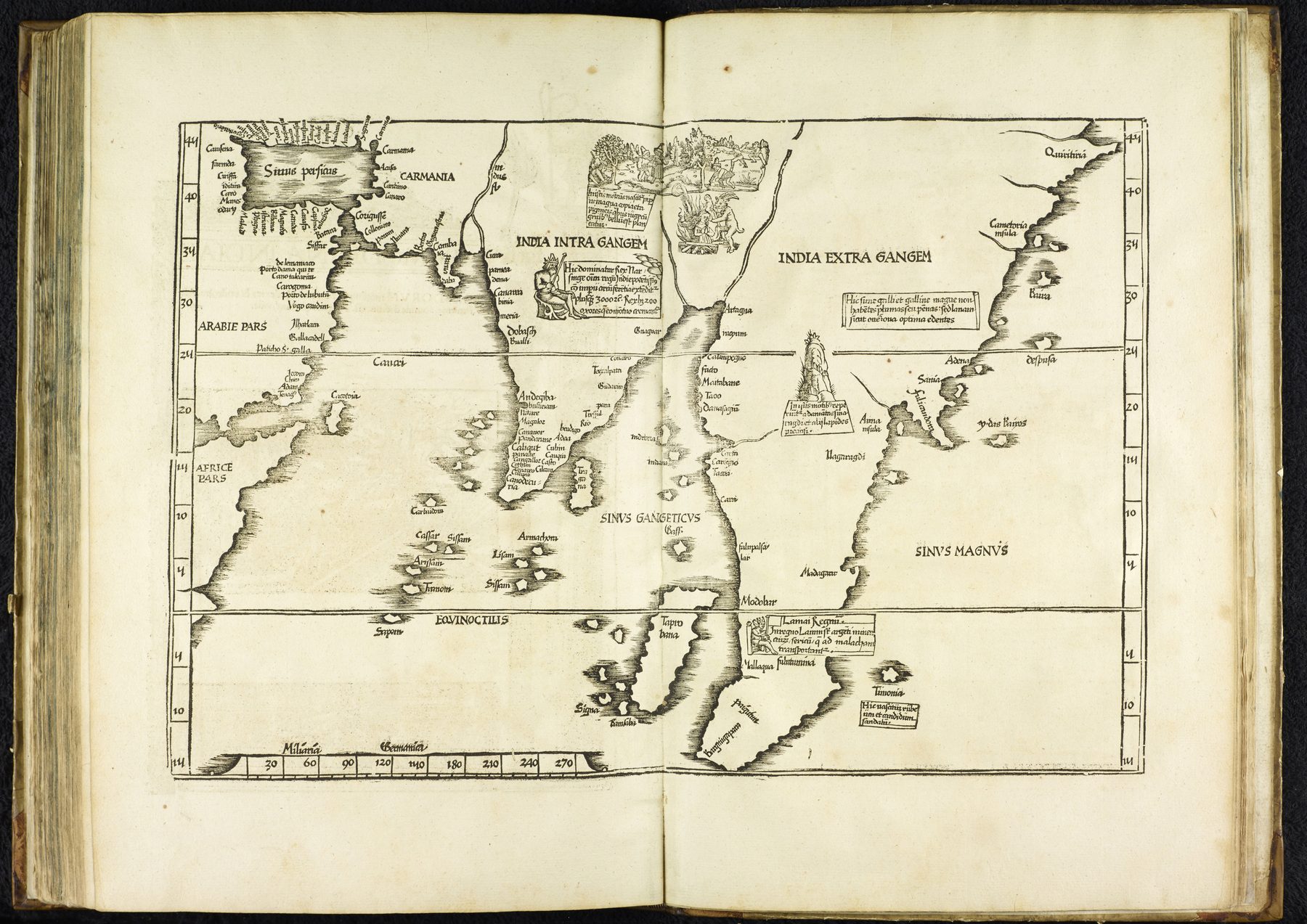
Tab. Moderna IndiaeClick to enlarge

Tab. Moderna Indiae

This image is a historical map titled "Tab. Moderna Indiae," part of an atlas published in 1525. The authors associated with this work are Jacopo D'Angelo, Joannes Regiomontanus, Willibald Pirckheimer, and Johann Grüninger. The map formed part of the "modern" (for that time!) version of Ptolemy's Geographies, and was printed by Johannes Koberger from woodblocks by Albrecht Dürer. It measures 41 cm in width and 27 cm in height.

Composition and Style

The map represents regions of India and Southeast Asia, distinguishing between "India Intra Gangem" (India within the Ganges) and "India Extra Gangem" (India beyond the Ganges). It employs a trapezoidal projection, a style developed by Nicolaus Germanus, which was common in maps of this period. The map is richly detailed with woodcut illustrations, a signature technique of the Renaissance period, reflecting the artistic influence of Albrecht Dürer.

Medium

The work is a woodcut map, utilizing techniques prevalent in the Renaissance for creating detailed and reproducible images. The map is part of a larger collection of 50 maps in the atlas, which includes both ancient and modern representations of the world.

Subject Matter

The map's subject is geographical, focusing on the Indian subcontinent and surrounding areas. It includes notable landmarks, coastlines, and regional names. Various inscriptions in Latin provide additional context, such as place names and geographical features like "Sinnus Gangeticus" and "Sinnus Magnus."

Cultural and Historical Context

This map was created during the Renaissance, a period of renewed interest in classical knowledge and exploration. It is part of a broader work that represents a significant advancement in geographic understanding during the early 16th century. The atlas is renowned for being among the first to include maps depicting newly discovered regions, such as Southeast Asia and the Americas.

Notable Features

- Landmarks: The map prominently features the Indian Ocean, labeled as "Sinnus Magnus," and includes the Arabian Peninsula, labeled "Arabie Pars." - Inscriptions: Latin inscriptions provide names and descriptions of regions, cities, and landscapes. - Illustrations: The map includes decorative elements, such as illustrations of people and creatures, which were common in maps of this period to fill empty spaces and add visual interest.

Atlas Details

The atlas is a world atlas featuring a combination of classical and newly discovered geographical knowledge. It contains 50 maps, with 27 based on Ptolemy and 23 reflecting contemporary discoveries. This edition was significant for being one of the first to include a map that names America.

Author
Ptolemy, Claudius; D'Angelo, Jacopo; Regiomontanus, Joannes; Pirckheimer, Willibald; Grueninger, Johann
Date
1525
Type
Atlas Map
Publisher
Koberger Emden Johannes a Lasco Bibliothek
Place
Strassburg
Dimensions
27 × 41 cm
Engraver
Dürer, Albrecht