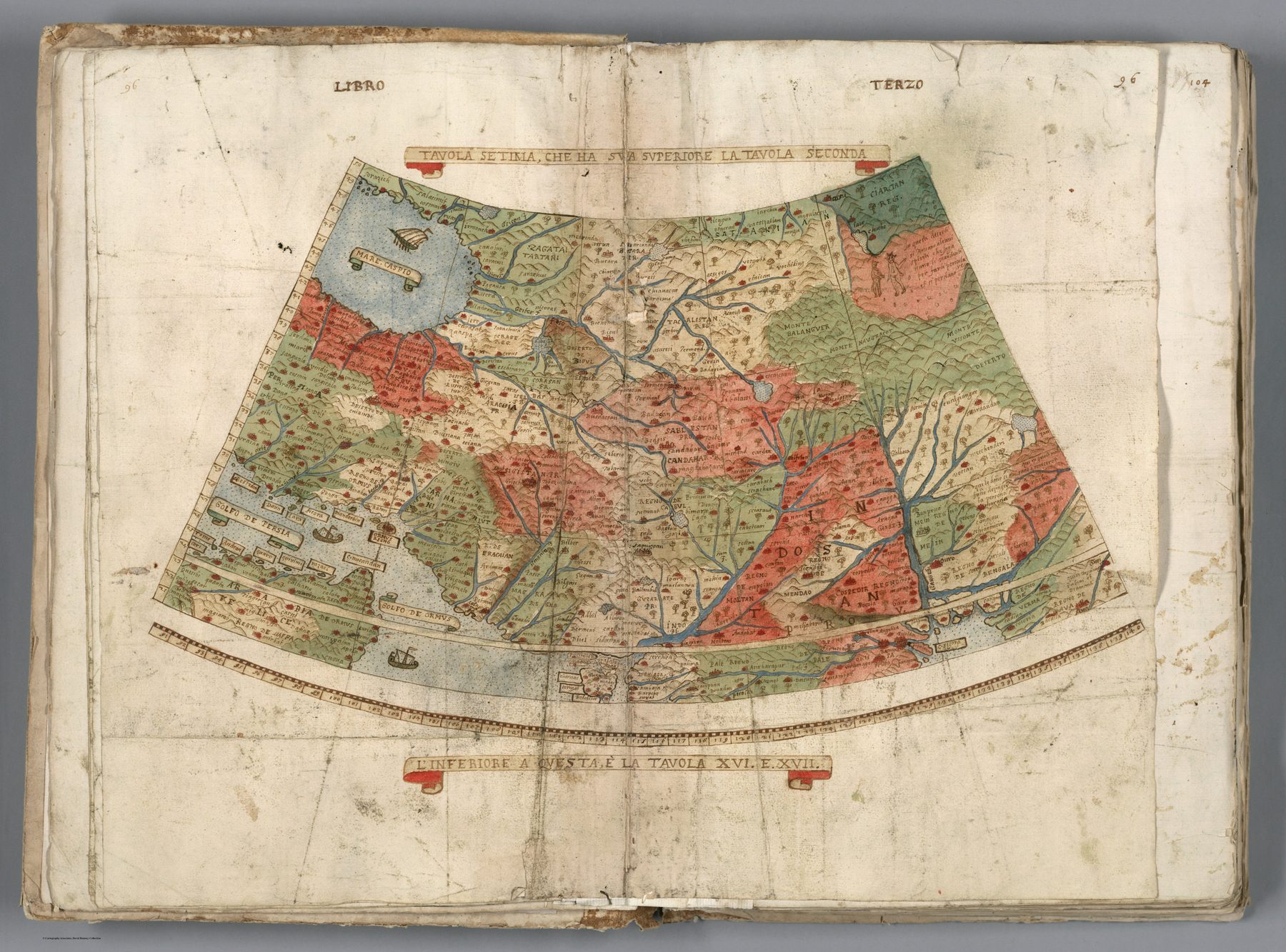
Tavola Setima, Che Ha Sua Superiore La Tavola Seconda. Libro Terzo
A sheet of a world
This is table seven of Urbano Monte’s manuscript atlas, one of sixty sheets designed to join into a planisphere approximately nine feet square. The individual leaf is therefore intentionally incomplete: its skewed borders and radiating meridians make sense only within the assembled circular earth.
The polar experiment
Monte projected the inhabited world outward from the North Pole. On this Asian sheet, familiar forms are rotated and stretched by the geometry of the whole. The projection was not chosen to make India independently legible; it was chosen to make the entire world simultaneously available to the viewer.
A manuscript encyclopaedia
The geography is substantially indebted to Mercator and other printed authorities, but Monte rewrote it by hand and surrounded it with rulers, peoples, animals, ships and annotations. The result is neither a navigational chart nor a conventional atlas page. It is a private cosmographic synthesis: geography presented as universal knowledge.
The gaze
India becomes one sector in a totalising visual system. Where Portuguese charts organise knowledge along sailed coasts, Monte’s map claims a view from above the globe itself. Its ambition is not territorial administration but intellectual possession—the whole earth brought within one circular field of sight.