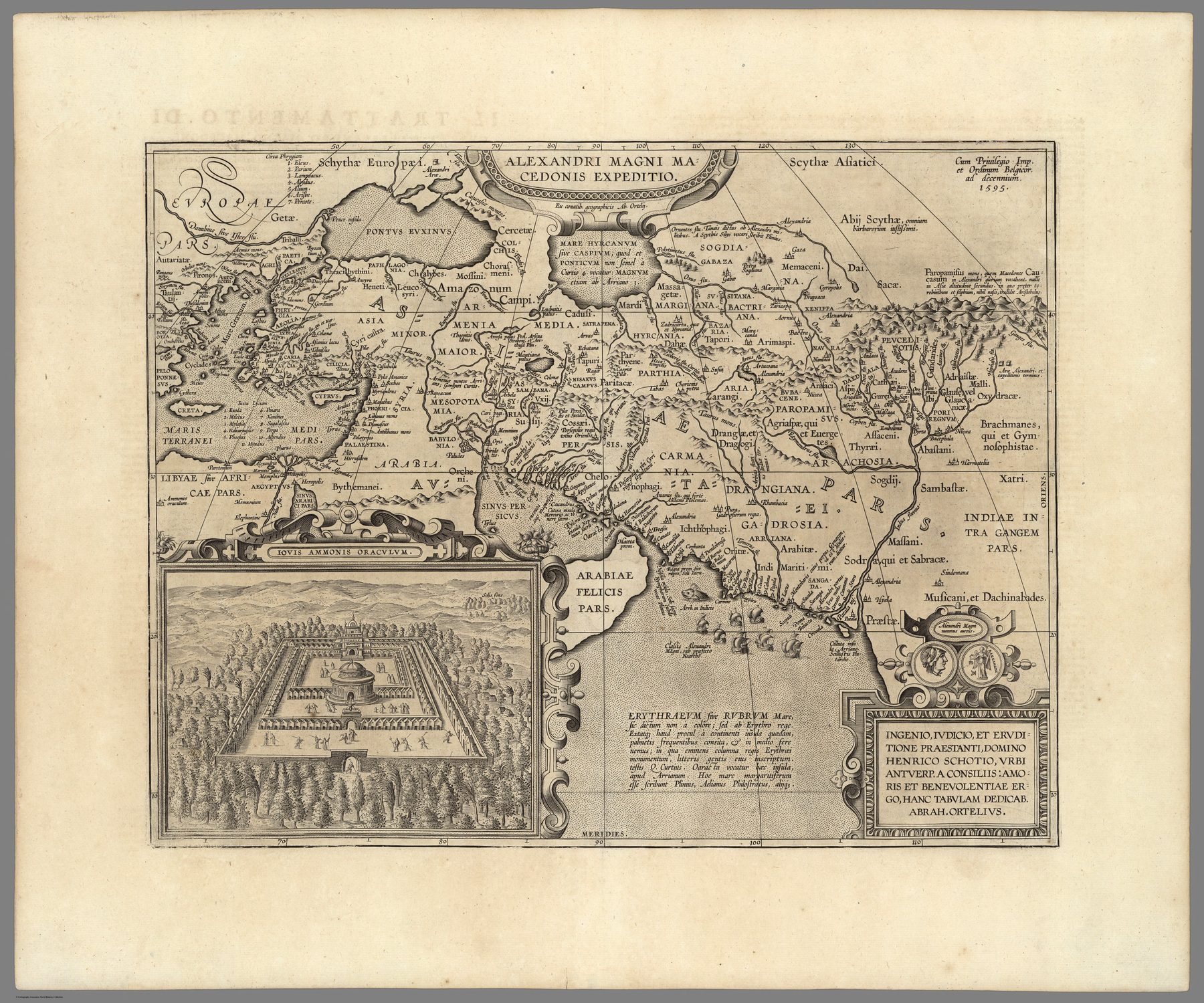
xxxiiii) Alexandri Magni Macedonis Expeditio
The plate and the impression
The plate is dated 1595 and belongs to Ortelius’s Parergon, the historical supplement to the Theatrum. The archive copy represented here was issued in the Italian Theatro del Mondo published by Jan Baptista Vrients after Ortelius’s death. Jan Wierix is credited as engraver.
Mapping a campaign
The map reconstructs Alexander’s movement from the Mediterranean world through Persia and Central Asia toward the Hydaspes and Indus. Its place-names, peoples and routes are derived from classical authors. The inset of the oracle of Ammon further announces that this is historical geography, not a description of contemporary Asia.
Humanist cartography
Unlike many maps in the Theatrum, which Ortelius reduced from modern authorities, the Parergon expressed his own antiquarian scholarship. Textual criticism became cartography: ancient narratives reconciled and converted into a spatial argument.
The gaze
India is positioned at the furthest reach of a European classical memory. The map does not ask what India was in 1595; it asks where Alexander went and how Greek and Roman writers described the world he crossed. Renaissance Europe looks east through antiquity’s eyes and recognises conquest as a route to knowledge.