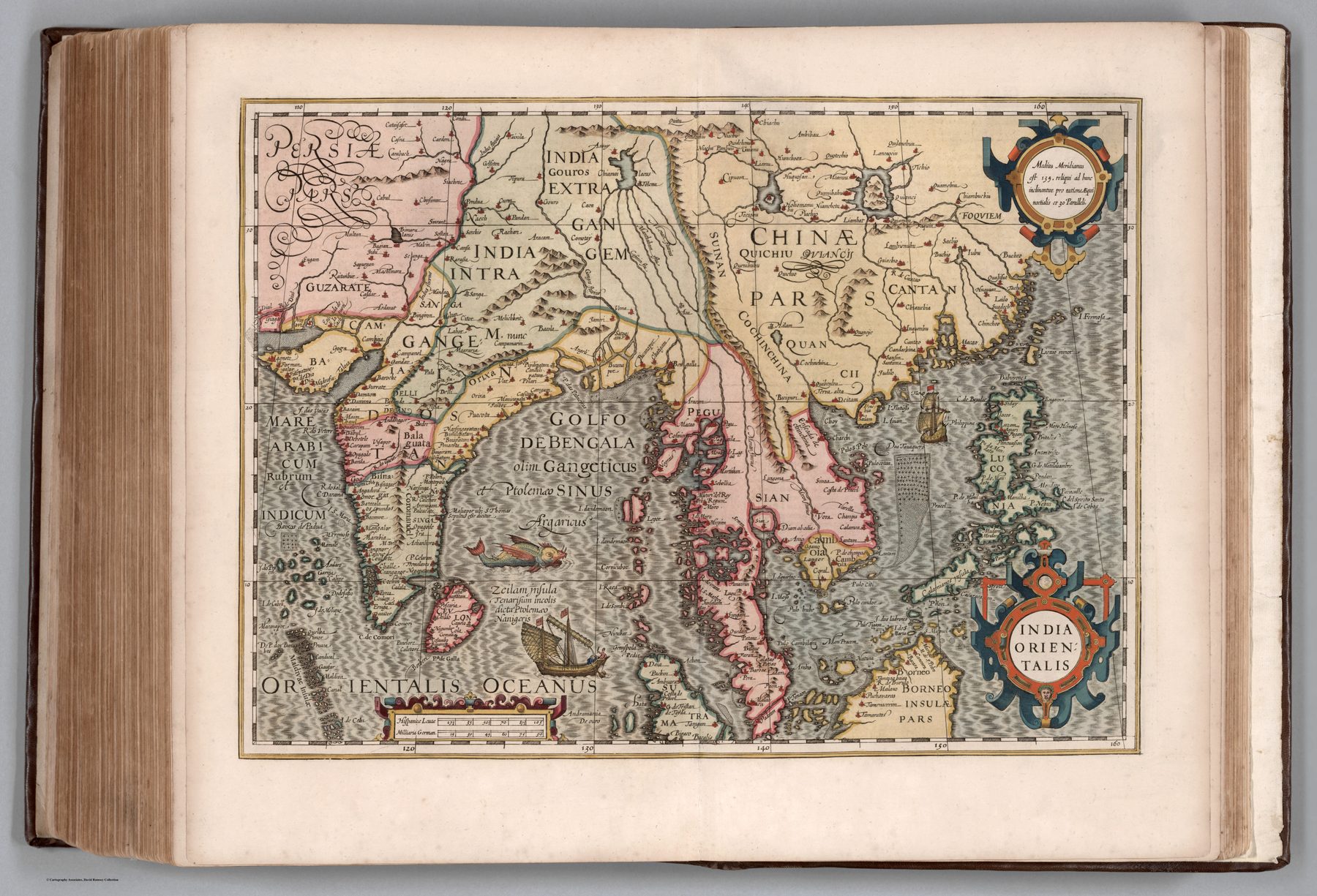
India Orientalis
An atlas lineage
Gerard Mercator’s plates passed after his death to Jodocus Hondius and then into the publishing enterprise of Henricus Hondius. The 1623 Latin atlas was the first edition to place Henricus’s name on the title page. This map belongs to that inherited and continually reissued corpus.
Established rather than newly surveyed
The plate extends from India through mainland Southeast Asia toward China. Its authority comes from the Mercator–Hondius house and from repeated publication, not from a fresh territorial survey. Decorative cartouches and carefully engraved coastlines give coherence to information accumulated over earlier decades.
Amsterdam and Asian commerce
By 1623 Amsterdam had become a principal centre of European map publishing, while the Dutch East India Company had established an extensive Asian commercial network. The map should not be read as a confidential VOC chart, but its market and confidence belong to the same commercial environment.
The gaze
The exploratory frontier has hardened into an accepted atlas image. India and the Indies appear knowable, nameable and saleable. Repetition converts compilation into apparent fact, giving metropolitan readers the impression of a settled geography even where knowledge remained uneven.