← Baroque Mughals and Companies
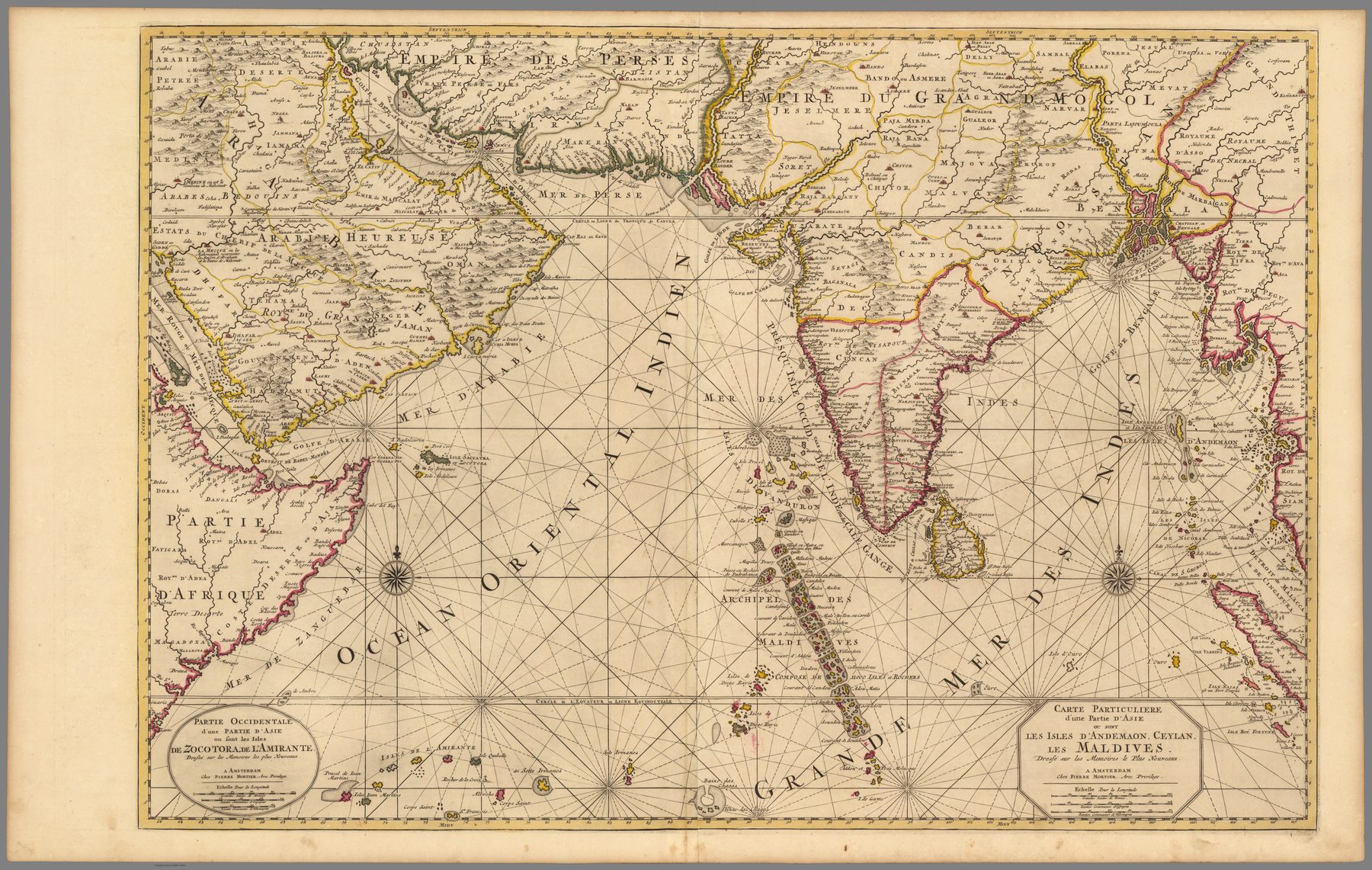
Carte Particuliere d'une Partie d'Asie ou sont les Isles d'Andemaon, Ceylan, les Maldives
A transnational atlas object
The map belongs to the Amsterdam publication of Alexis-Hubert Jaillot’s cartography by Pierre Mortier. Its intellectual lineage runs through Nicolas Sanson; its engraving and commercial setting are Dutch. The object therefore resists any simple national label.
The maritime region
Rather than presenting India as an isolated landmass, the sheet foregrounds the islands and waters through which traffic moved: Ceylon, the Maldives, the Andamans and the surrounding seas. At this scale, maritime geography becomes a region in its own right.
Authority through enlargement
Mortier’s large-format atlas transformed French source maps into imposing commercial plates. Scale, engraving and presentation amplify authority even where the underlying geography remains derivative. The map is an artefact of publishing competition as much as of geographical observation.
The gaze
India’s seas are divided into legible strategic spaces. Islands become waypoints, hazards and possessions within a network connecting European companies to South and Southeast Asia. The gaze is maritime, regional and commercially systematised.