← Baroque Mughals and Companies
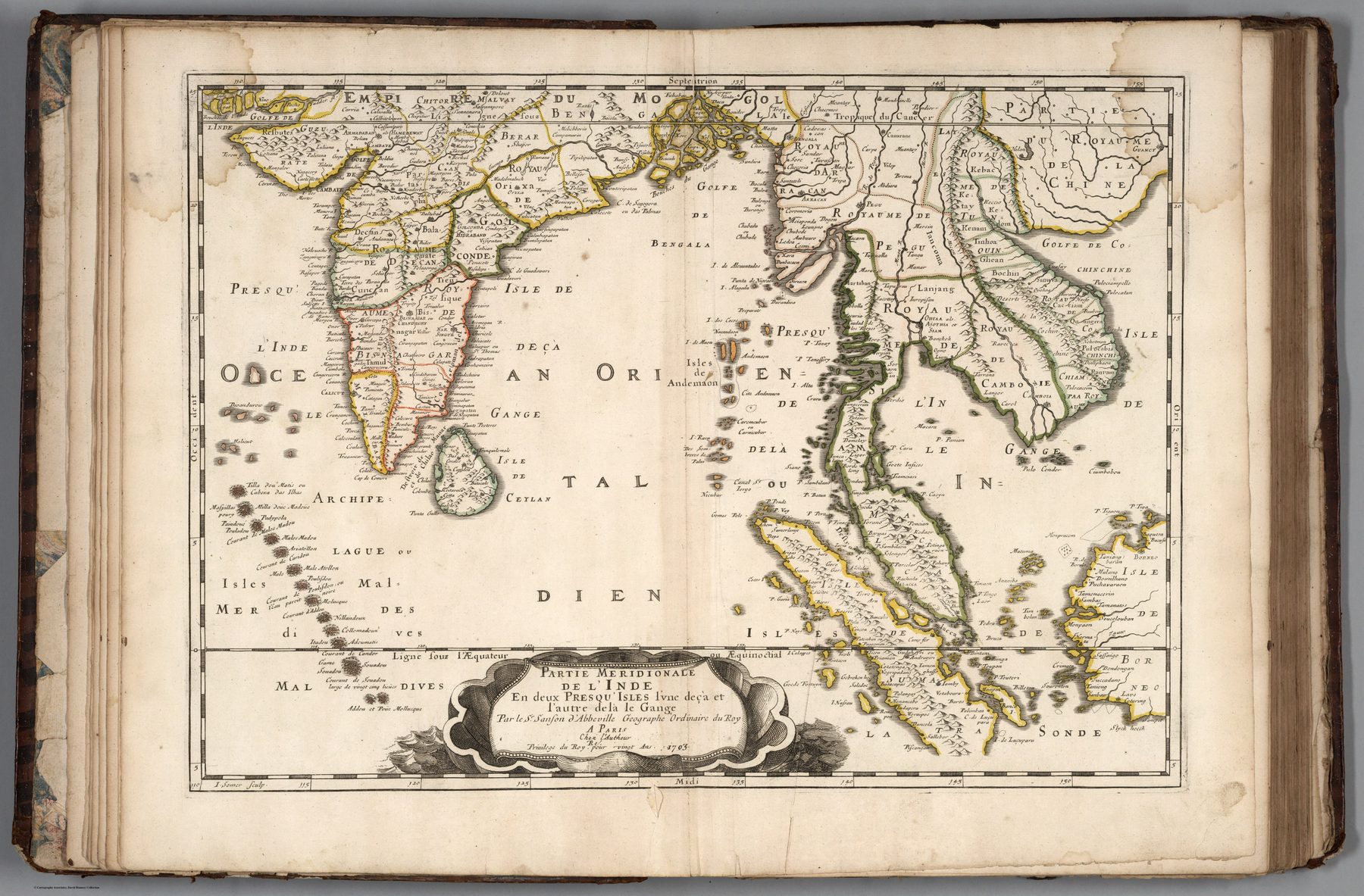
India and Southeast Asia
The full title as argument
Partie Méridionale de l’Inde en deux presqu’îles, l’une deçà et l’autre delà le Gange names its organising scheme explicitly. The Indian peninsula and mainland Southeast Asia are treated as the two peninsulas of a larger India.
An ancient division in modern form
The distinction descends from Ptolemaic geography, yet the sheet is engraved in the restrained style of the French school and populated with early-modern place knowledge. It therefore demonstrates how older conceptual categories survived within increasingly critical cartography.
Coasts and interiors
Maritime edges, ports and major political names receive the clearest treatment. Inland information is thinner and more uneven. The map’s apparent clarity should not be mistaken for uniform empirical knowledge across the territory it represents.
The gaze
Europe has updated what it knows without fully changing how it divides the region. India is modernised inside an ancient frame—a reminder that cartographic progress consists as much in persistent categories as in corrected coastlines.