← Baroque Mughals and Companies
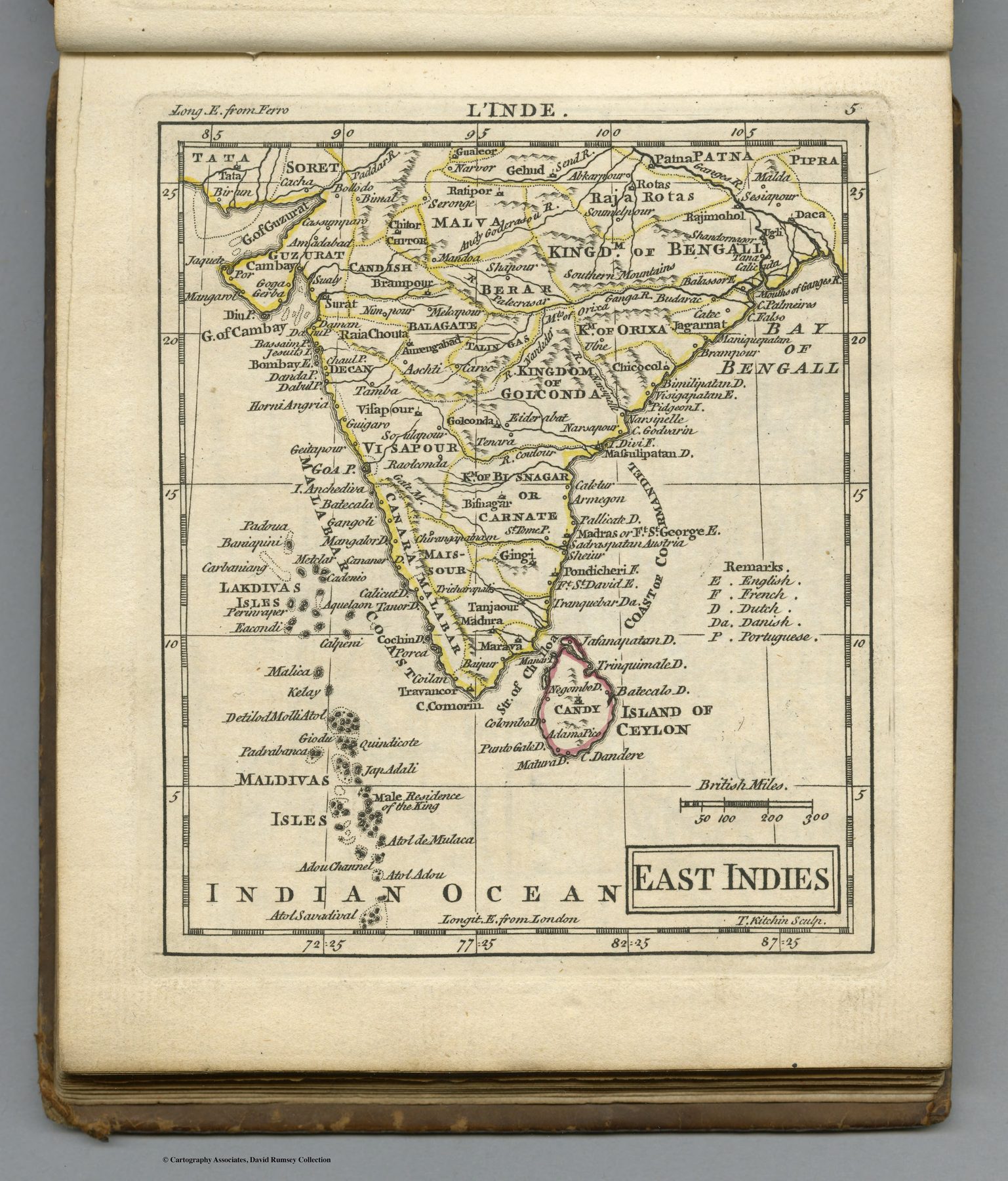
East Indies
The pocket atlas
Dury’s New General and Universal Atlas contained forty-five small maps intended for convenient consultation. This plate, engraved by T. Kitchen, compresses the East Indies into a sheet only about thirteen by eleven centimetres.
A derivative map at a consequential date
The geography is not revolutionary and appears to draw upon French models. Its date is nevertheless significant. The Treaty of Paris ended the Seven Years’ War in 1763, while the East India Company had already gained a decisive position in Bengal after Plassey. The map does not cause or fully describe that transformation; it belongs to the metropolitan print culture in which it became imaginable.
Bilingual and portable
French titles accompanying the English atlas reinforce the international circulation of cartographic models. Geographic authority moved readily between Paris, Amsterdam, Venice and London even as the states and companies represented on the maps competed violently.
The gaze
India appears as part of a world Britain can carry in a pocket. The map’s modest scale is historically revealing: imperial geography becoming ordinary printed knowledge at the moment commercial supremacy was acquiring territorial consequences.