← Baroque Mughals and Companies
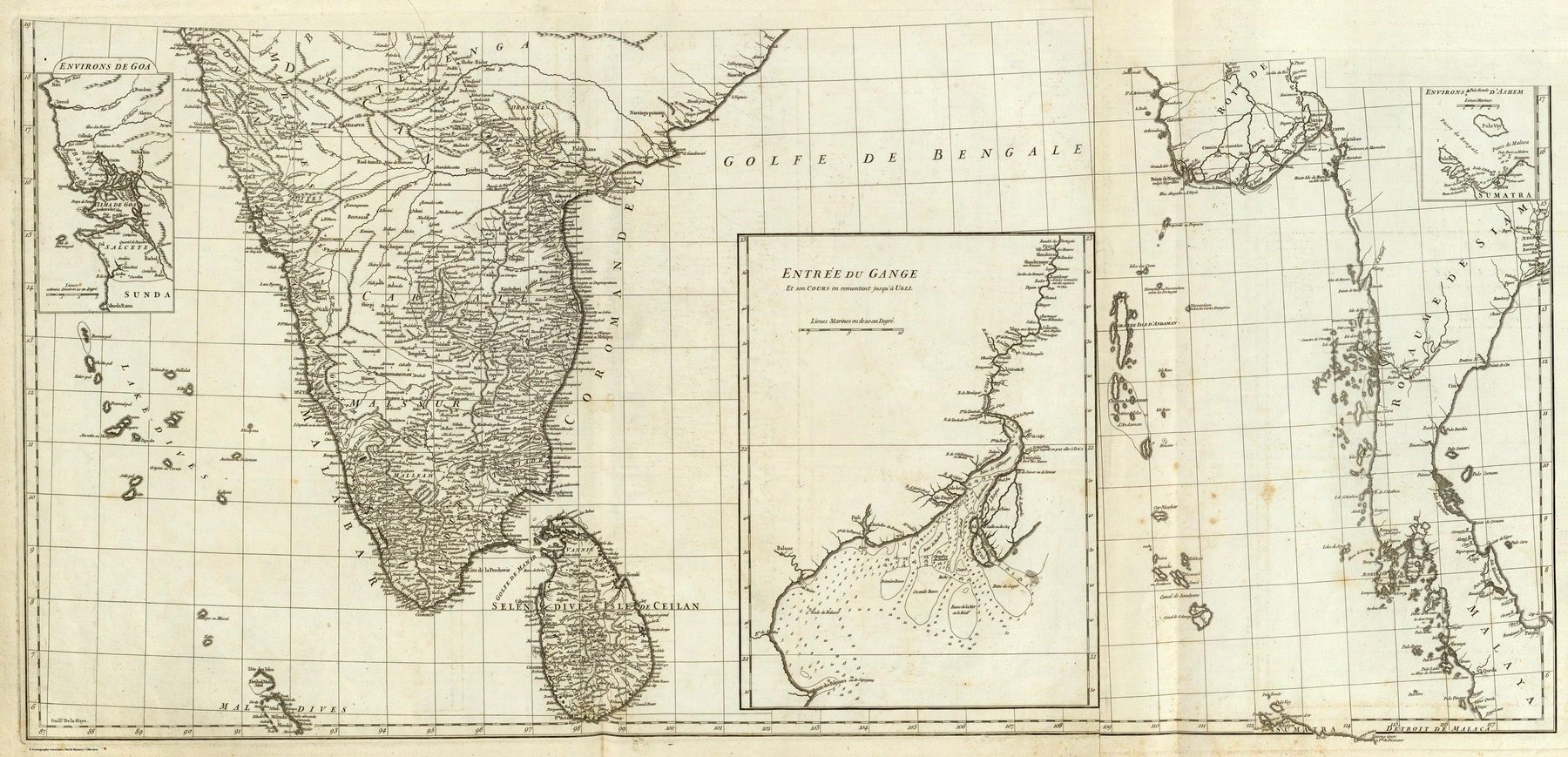
Carte de l’Inde — southern sheets
The lower pair of sheets from d’Anville’s four-sheet Carte de l’Inde isolates the part of the map where his evidence was richest: the peninsula, Ceylon, the Bay of Bengal and the commercial approaches to Goa and the Ganges. Shown separately, it reveals the uneven geography of information on which the celebrated composite depended.
A component, not a second map
This object is the southern half of d’Anville’s larger Carte de l’Inde, engraved on two sheets and mounted as one in the Rumsey copy. It should be read beside the joined composite rather than as an independent conception. Its value here is scale: the component sheet permits closer attention to the peninsula and to the inset plans embedded in the larger work.
Where information gathers
D’Anville’s critical method produces an uneven surface. Coastal South India is comparatively dense with towns, routes and political names because navigators, merchants, missionaries and company servants had generated repeated reports. The insets of the environs of Goa, the entrance to the Ganges and the environs of Ashem concentrate attention on places where commerce, navigation and European strategic interest produced more exact information. Soundings in the Ganges delta make the connection between geographic scholarship and maritime use explicit.
Why show the sheet separately?
The full composite is best for seeing d’Anville’s famous restraint — detail thinning into blank where evidence failed. The southern sheets show the converse: how much could be assembled where routes of observation were thickest. They make visible that cartographic “accuracy” was not distributed evenly across India; it followed the institutions and pathways through which information reached Paris.
The gaze
D’Anville never surveyed this ground. His achievement was to judge sources at a distance and refuse to fill every gap. Yet the geography of reliable knowledge still follows French commercial and scholarly access. The sheet is therefore both a landmark of critical cartography and a record of the unequal channels through which India became knowable to a European company geographer.
Source and image
David Rumsey Historical Map Collection, List No. 2603.021: catalogue record and zoomable image. The record identifies the two-sheet engraving, its three insets and soundings in the Ganges delta.