← Home Ground Bombay and Deccan
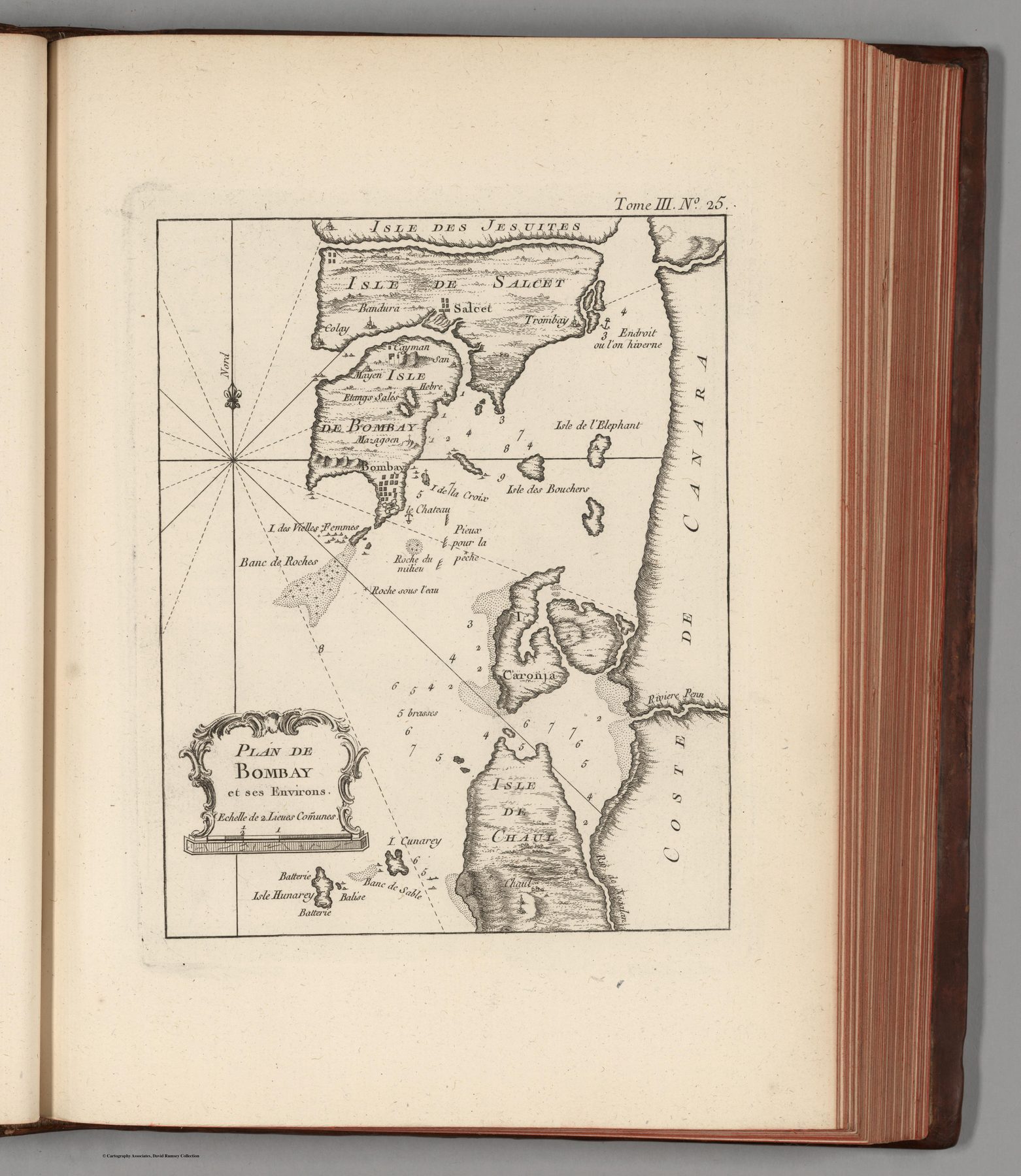
Plan de Bombay
The chart
Bellin was engineer and hydrographer to the French naval establishment. His 1764 Petit Atlas Maritime gathered hundreds of coastal charts and harbour plans. This plate, engraved by J. Arrivet, shows Bombay with pictorial relief, settlements and depth soundings.
A harbour rather than a country
The navigational problem determines what is included. Water depth, approach and anchorage matter more than inland political geography. Bombay is represented as an island harbour to be entered and used, not as a city embedded in the later metropolitan landscape.
Knowledge of a rival possession
Bombay was British, but a French maritime atlas had every reason to record it. Hydrographic knowledge crossed political boundaries because rival navies and merchants needed to understand the same ports. The map belongs to a European archive of strategic observation rather than to a single imperial administration.
The gaze
The collection’s home ground first appears from offshore. Bombay is appraised through the needs of navigation and competition—its waters measured before its streets are administered. The territorial gaze tightens by way of the harbour.