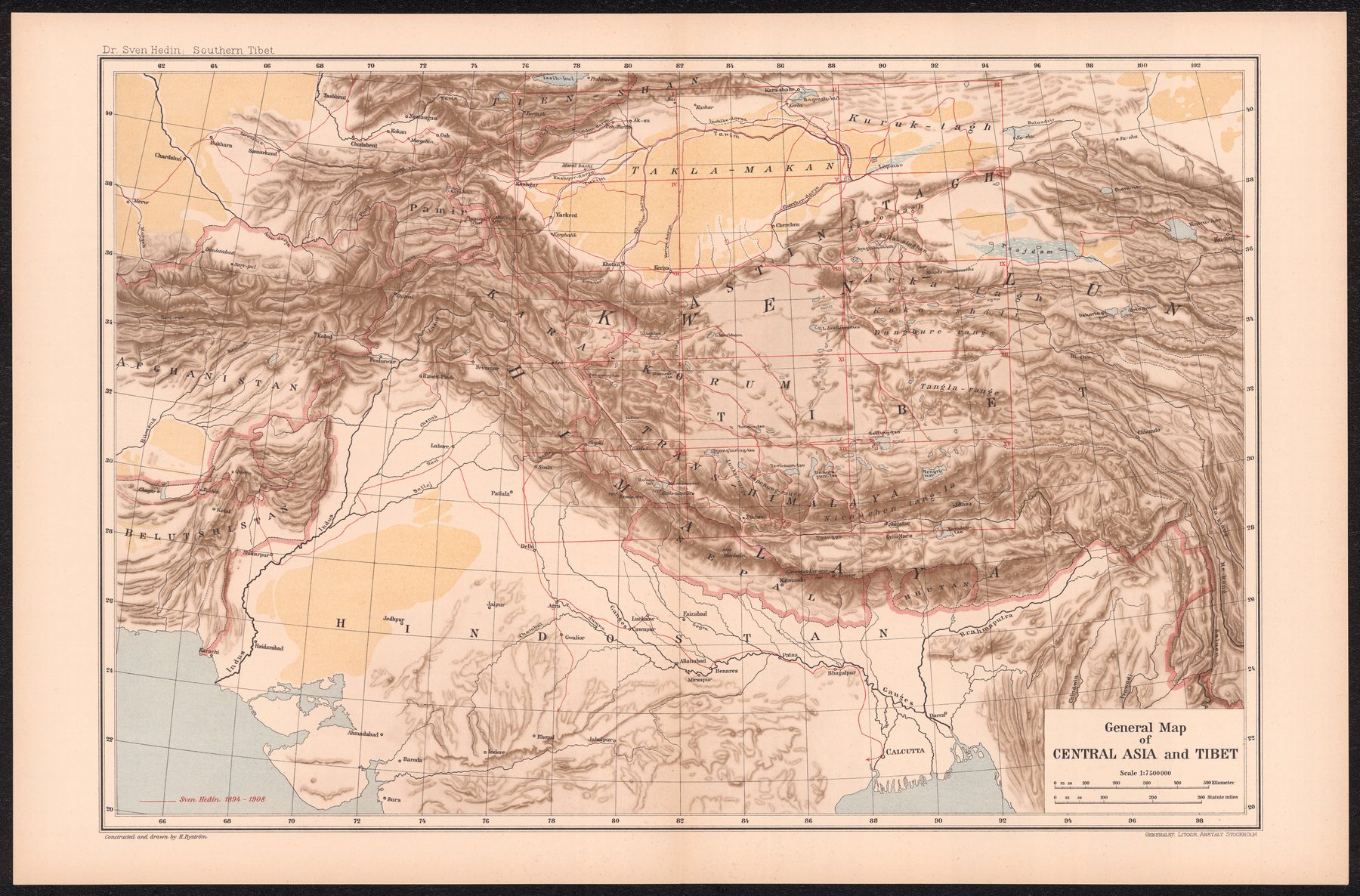
General Map of Central Asia and Tibet
The published synthesis
The map was produced for Hedin’s Southern Tibet project with cartographic work by Otto Kjellström, H. Byström and the lithographic institute of the Swedish General Staff. It condenses a much larger corpus of route surveys, observations, sketches and specialist maps into one regional overview.
Exploration and compilation
Hedin’s expeditions supplied substantial new measurements, but the general map is not the work of a solitary eye. It is an institutional publication combining field observation, drafting, calculation, lithography and existing geographic knowledge.
A strategic highland
Central Asia and Tibet mattered to European science and to the strategic imagination surrounding India’s northern approaches. The sheet sits at the intersection of exploration, physical geography and the geopolitics of frontiers.
The gaze
The remaining “blank” is approached as a problem to be measured and integrated into a regional system. Yet the map also exposes the persistence of the explorer’s gaze: distant territory acquiring authority through the named expedition and the institutions that publish it.