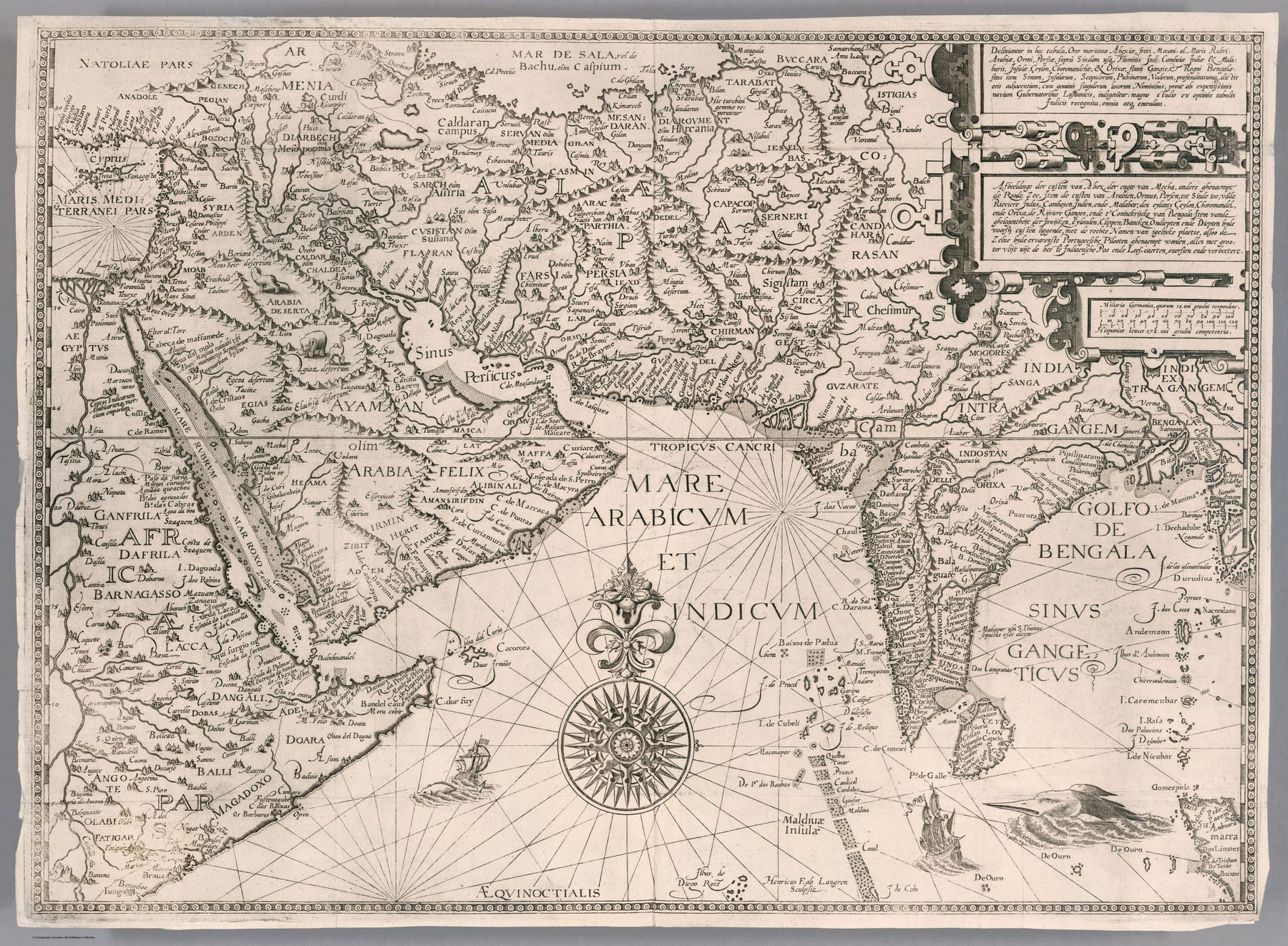
Southwest Asia. Definiantur in hac tabula, Orae maritimae Abexie, freri Mecani al Maris Rubri Arabiae
The object and its editions
Jan Huygen van Linschoten assembled the geographical and sailing intelligence he had encountered while serving in Portuguese Goa. The chart was first issued with the Dutch Itinerario in the 1590s; the particular archive record underlying this page is from a later French edition published at Amsterdam in 1638. The historical date and the date of this impression should therefore not be confused.
From the Red Sea to Bengal
The sheet follows the maritime approaches to India rather than the political shape of the subcontinent. Arabia, the Persian Gulf and the Indian coastline are organised as a chain of routes, anchorages and coastal knowledge. Henricus van Langren’s engraving turns working intelligence into a map that can circulate.
Breaking a monopoly of information
Portuguese sailing directions were valuable because they condensed experience of monsoon winds, hazards and ports. Linschoten’s publication did not simply add geographical facts to European libraries; it redistributed operational knowledge. Dutch and English expansion followed, although no single book by itself caused that transition.
The gaze
India is seen as a navigable commercial opportunity. The map’s power lies less in territorial completeness than in access: knowledge once tied to Portuguese service is detached from its institutional owners, printed and offered to rival merchants and states.