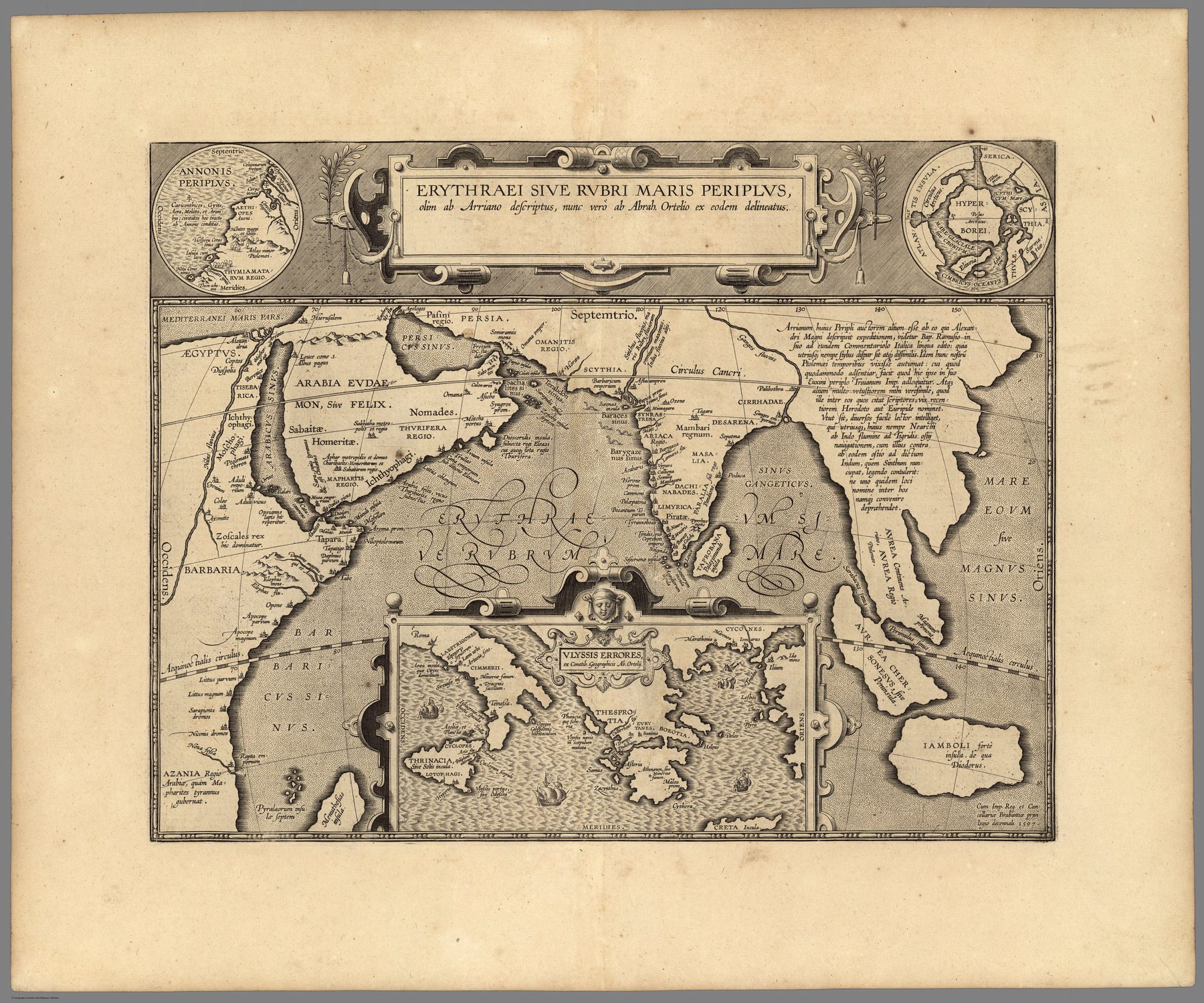
xxxvi) Erythraei Sive Rubri Maris Periplus
A map made from an ancient text
This 1597 plate belongs to Ortelius’s Parergon. Its title identifies the Erythraean—or Red—Sea in the broad ancient sense, encompassing the Red Sea, Arabian Sea and Indian Ocean. Ortelius drew the map from classical authorities rather than from contemporary navigation.
Ports of the classical trading world
The sheet gives spatial form to the emporia, coasts and routes associated with ancient commerce between the Mediterranean, Arabia, East Africa and India. The Indian subcontinent appears not as a bounded modern polity but as a sequence of ports at the end of a maritime network described in Greek and Roman texts.
History, myth and geography
The inset tracing the wanderings of Ulysses makes the map’s intellectual world explicit. Ortelius’s ancient geography did not enforce the modern distinction between commercial record, historical reconstruction and literary memory. All were parts of the classical archive he sought to visualise.
The gaze
India is recovered as a place antiquity already knew through trade. The map allows Renaissance readers to place recent Portuguese voyages within a much older maritime history, appropriating the Indian Ocean through classical scholarship as well as contemporary navigation.