← Baroque Mughals and Companies
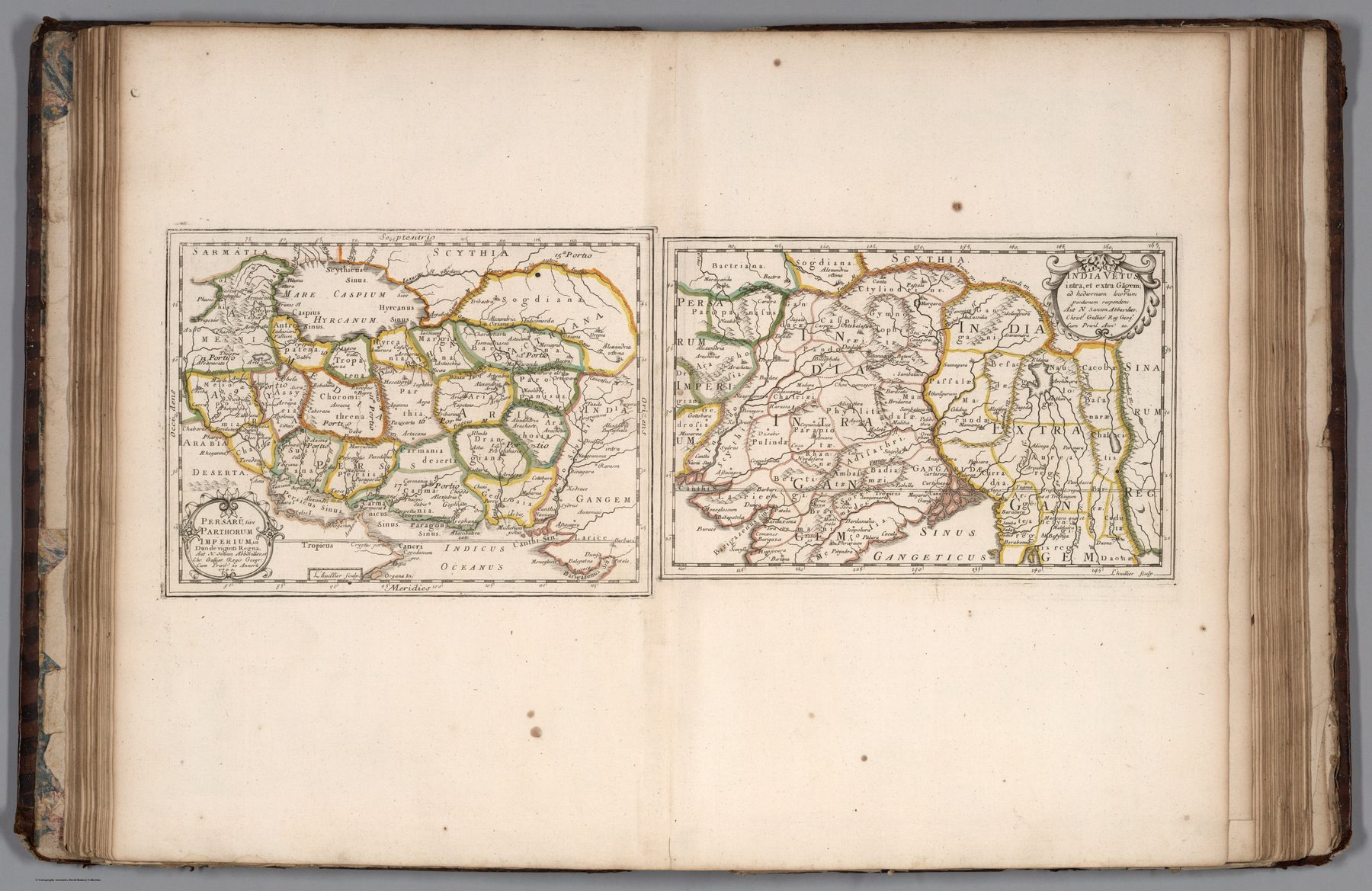
Old Persia and Old India
Ancient and modern geography
The Sanson atlas deliberately placed classical geography beside contemporary maps. This sheet contains two ancient worlds on one page: the Persian and Parthian empires at left and ‘Old India’ at right. It belongs to a publication whose title page is dated 1697 but whose individual maps extend into the following decade.
Reconstructing India from texts
India Vetus uses the names and divisions of Greek and Roman geography rather than those of the early eighteenth century. Rivers, regions and peoples are arranged as scholarly evidence. The map is consequently historical even though it is drawn with the conventions of contemporary French cartography.
Comparison as method
The same publishing house could map India twice: as the Mughal polity of the present and as the India of classical authors. Knowledge was understood diachronically. To know a country meant to compare what ancient texts said with what modern geographers believed.
The gaze
India is approached from the library. The map treats the subcontinent as an object of European erudition, recoverable through textual criticism and capable of being placed within a universal history of empires.