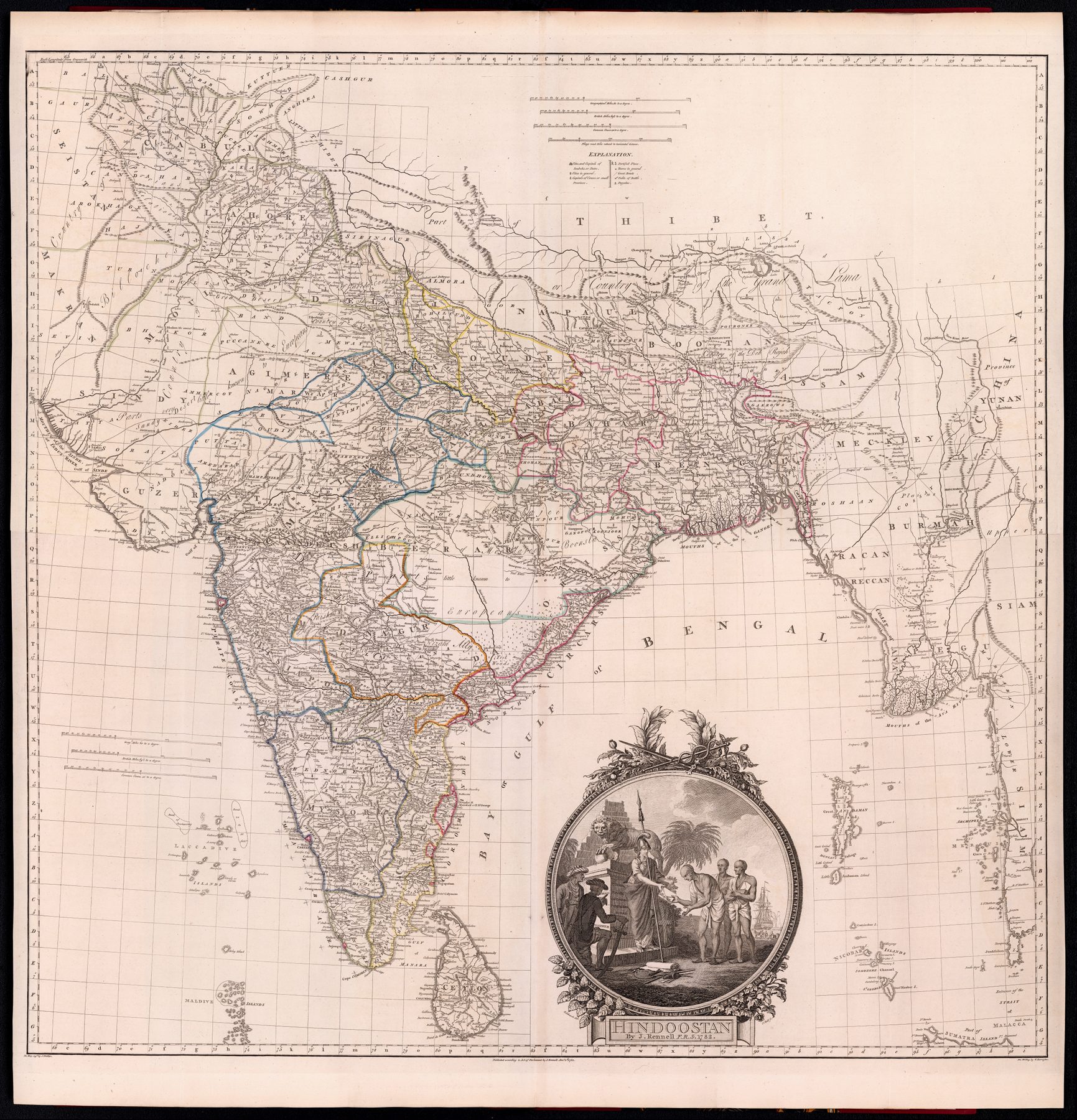
Hindoostan by J. Rennell F.R.S.
A general map built from unequal knowledge
Rennell served as Surveyor-General of Bengal from 1767 to 1777, directing extensive route and district surveys in the territories then controlled by the East India Company. This general map carried that measured knowledge beyond Bengal by combining it with itineraries, astronomical positions, earlier maps and information supplied by travellers and Indian informants. It is therefore neither a wholly first-hand survey of India nor a mere library compilation: its authority comes from joining new field measurement to the best intelligence available elsewhere.
The object and its issues
The plate is dated 1782 and was engraved on two sheets. The example catalogued here occurs in Rennell’s 1783 Memoir of a Map of Hindoostan; another state was associated with the Bengal Atlas. The distinction matters because the map, its accompanying text and later editions developed together as Rennell revised his account of the subcontinent.
Survey, administration and display
Roads, rivers, political divisions and measured positions turn a varied landscape into a connected territorial field. The cartouche makes the political setting explicit: Britannia receives the products and knowledge of India. Measurement appears as enlightened scholarship, but it also makes routes, jurisdictions and resources available to a government whose territorial power was expanding.
The gaze
The change is methodological before it is visual. India is no longer only a shape reconciled from European authorities; it is increasingly a country traversed, measured and made commensurable from within. Yet the resulting view remains institutional: local knowledge and labour enter the map through a Company survey and largely disappear behind Rennell’s name.