← Home Ground Bombay and Deccan
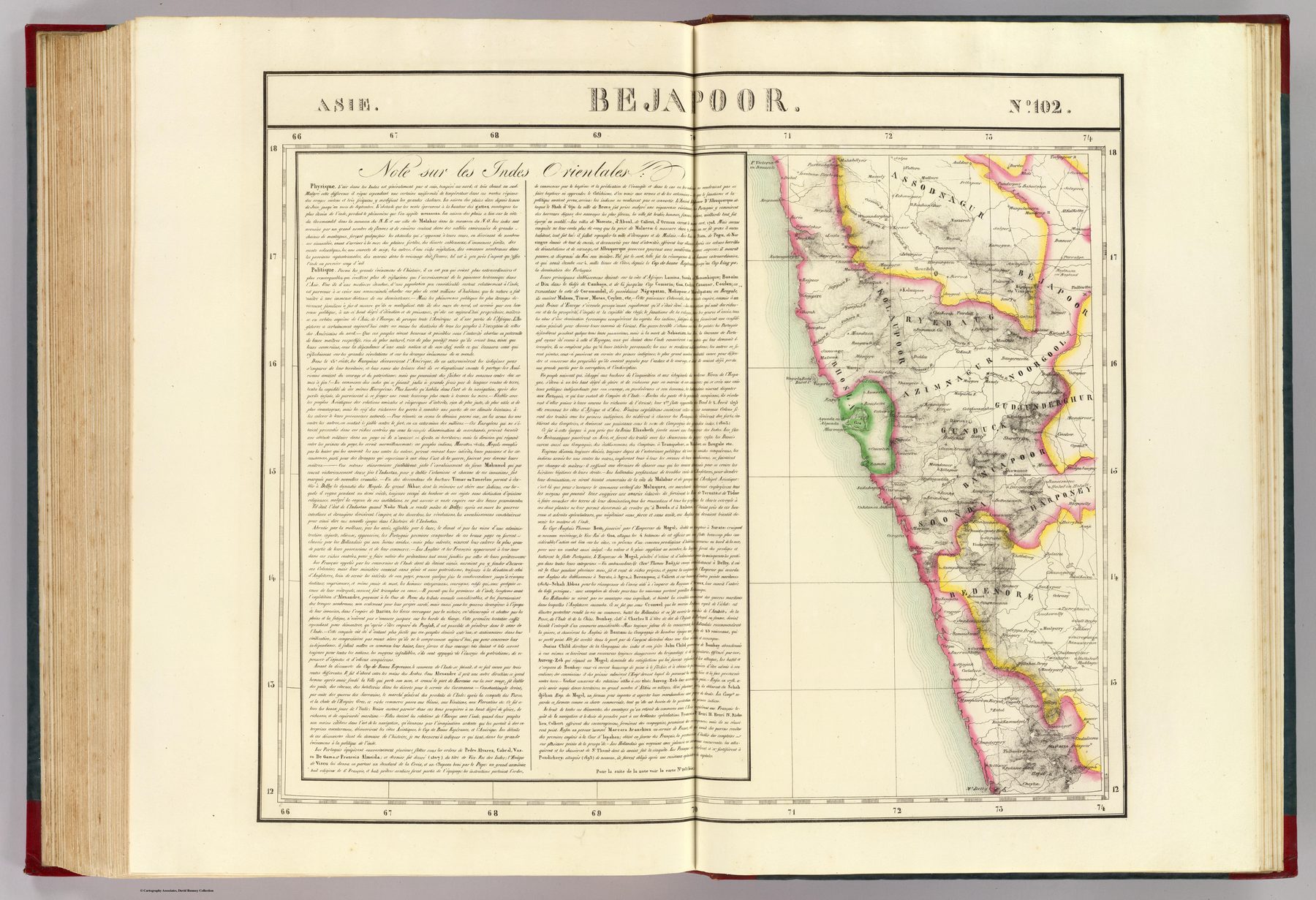
Bejapoor — Asie 102
A universal scale
Vandermaelen’s six-part Atlas Universel mapped the entire world at the common scale of 1:1,641,836. Its sheets could theoretically be assembled into a globe almost eight metres in diameter. This plate, Asia no. 102, covers the Bijapur region and was lithographed by Henri Ode; a geographical note by A. Delavault continues across adjoining sheets.
The grid determines the region
The boundaries of the sheet are not those of a kingdom, province or natural region. They are produced by the atlas grid. Bijapur is therefore encountered as a segment of a continuous mathematical surface, designed to join seamlessly to neighbouring segments.
Lithography and systematic geography
The atlas was also among the earliest monumental cartographic projects produced by lithography. The method supported an ambitious programme of standardised reproduction: different places, however unequal the underlying information, could be issued in an identical visual and dimensional system.
The gaze
The Deccan is made commensurable with the rest of the earth. The gain is comparative clarity; the loss is the illusion that all parts of the world are known with equal authority. Uniform scale can conceal uneven evidence.