← Home Ground Bombay and Deccan
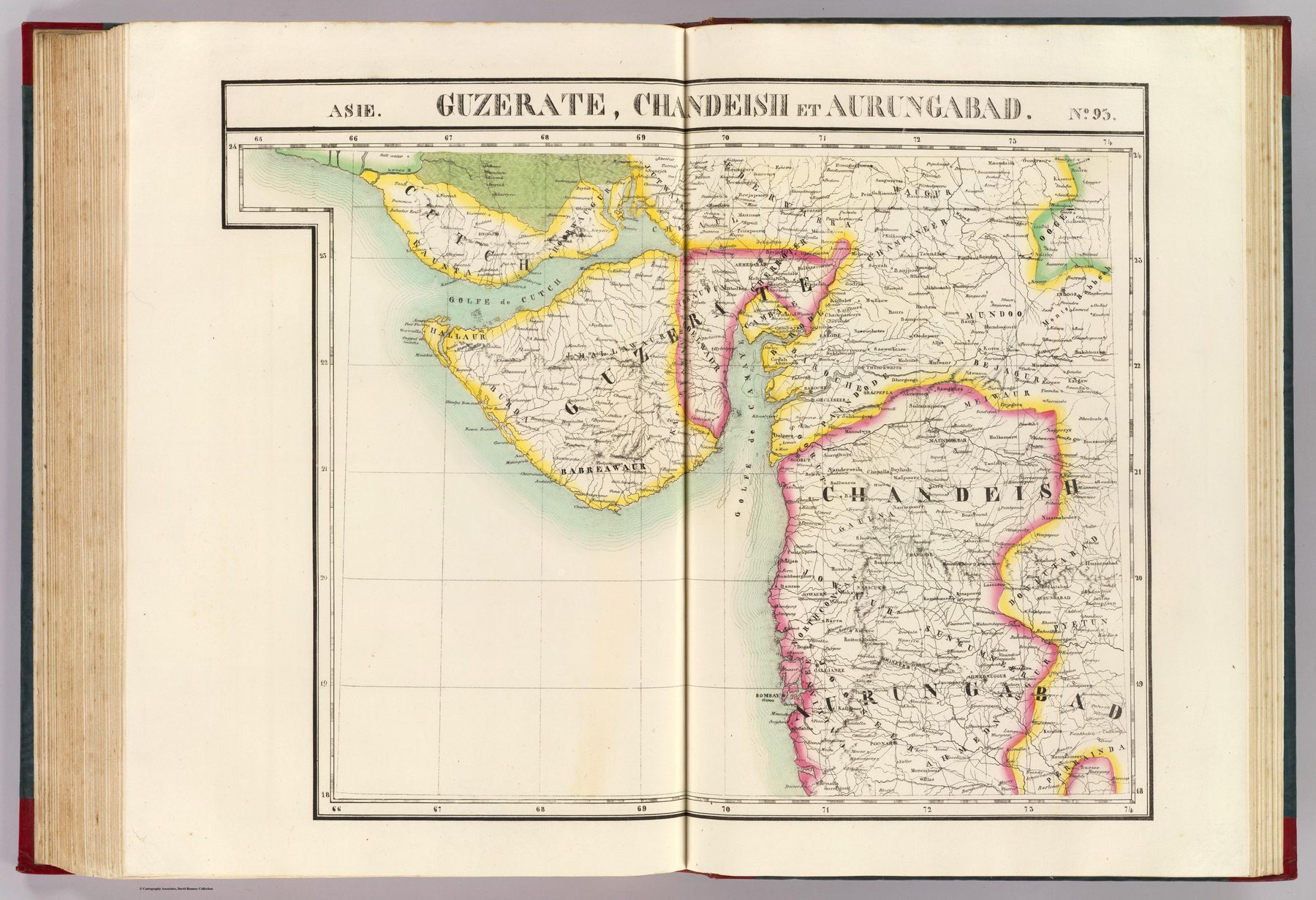
Guzerate, Chandeish et Aurungabad — Asie 93
A neighbouring tile
Asia no. 93 belongs to the same uniform-scale Atlas Universel as the Bijapur sheet. Lithographed by Henri Ode, it covers Gujarat, Khandesh and the Aurangabad country at 1:1,641,836, with relief represented pictorially and longitude measured from Paris.
Irregular shape, regular system
The plate’s unusual outline is generated by the projection and the requirement that it meet adjoining sheets. The local region is not centred for its own sake. It is clipped and angled so that the atlas can maintain a single globe-wide geometry.
The gaze
Vandermaelen’s achievement is universal comparability. Its danger is universal confidence. A place shaped by Maratha, Mughal, Company and regional histories appears as one technical unit among hundreds, absorbed into a system that promises to make every territory equally legible.