← Administered Empire and Victorian Atlas
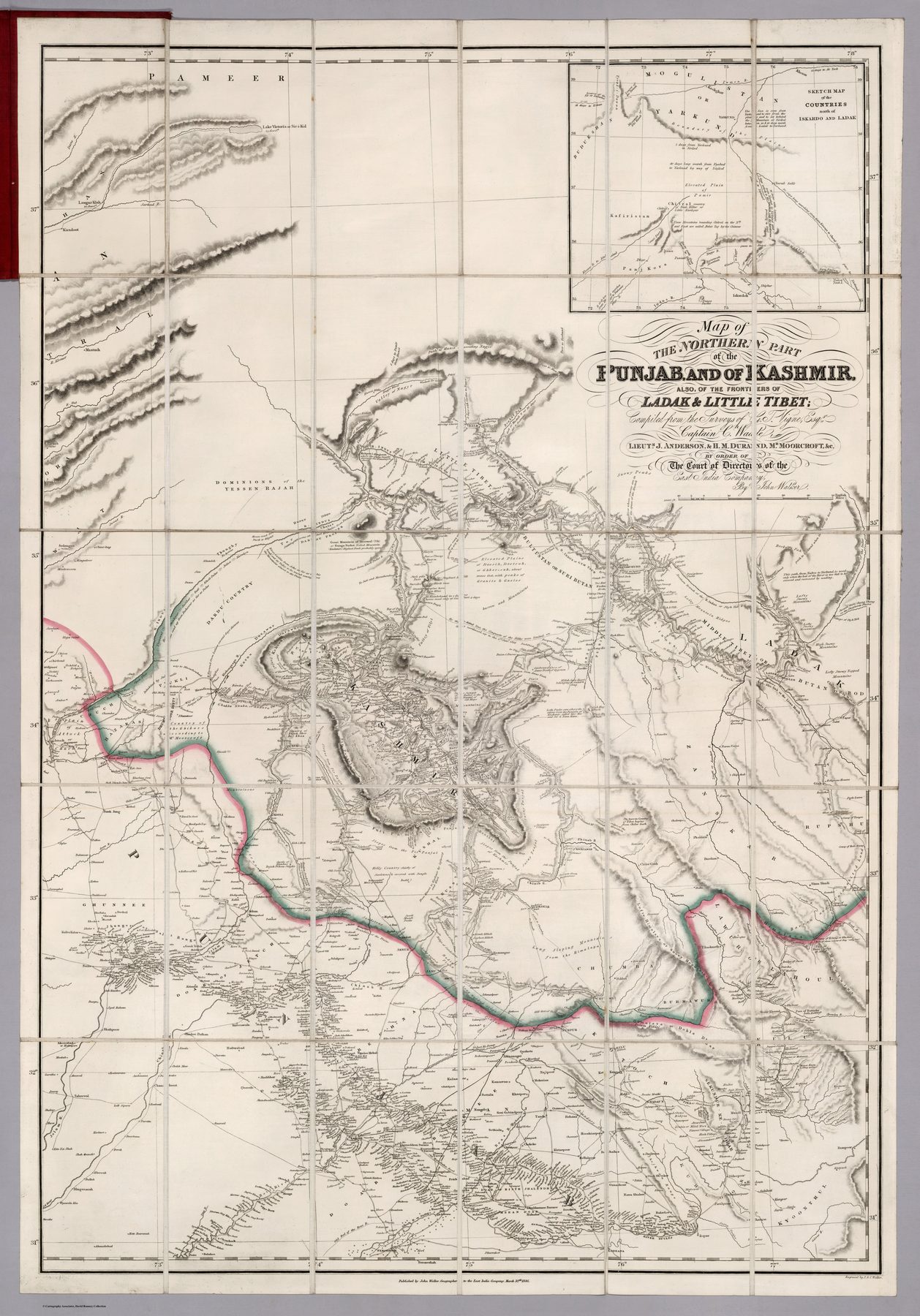
Northern Punjab, Kashmir, Ladak and Little Tibet
A composite frontier geography
Walker compiled the map from the surveys and travels of G. T. Vigne, Captain C. Wade and Lieutenants J. Anderson and H. M. Durand. J. & C. Walker engraved it as a large folding case map. Its coverage stretches from the Punjab plains through the Vale of Kashmir and the mountain routes toward Ladak and ‘Little Tibet’.
Published in a political hinge year
The map was issued on 30 March 1846, after the First Anglo-Sikh War and the treaties that transformed the political position of Kashmir and the Punjab. It should not be treated as a neutral retrospective record of those events: the East India Company required improved knowledge of roads, passes, forts and terrain while deciding how power and administration would operate across the region.
Uneven information at the frontier
The map joins measured routes, travellers’ observations and fragmentary intelligence. Density decreases toward the high mountain margins, but the sheet’s single engraved surface can make radically unequal kinds of evidence appear equally secure.
The gaze
This is frontier cartography in the literal sense: knowledge pushed toward strategic edges before administrative control was complete. The map assists surveillance, movement and boundary-making, while converting the contingent reports of travellers and local intermediaries into Company authority.