← Administered Empire and Victorian Atlas
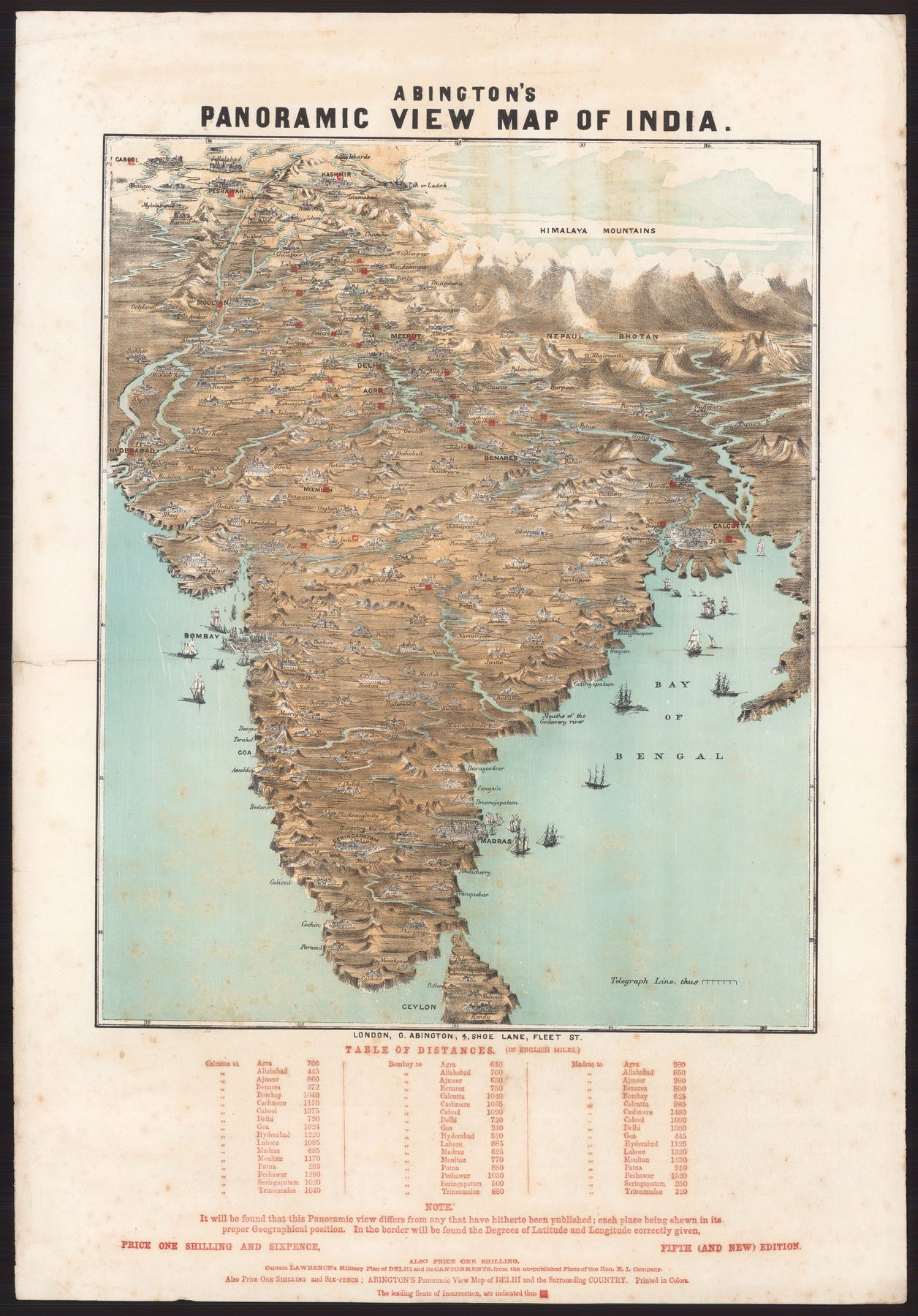
Abington’s Panoramic View of India
Date and object
The panorama was advertised during 1857, while surviving examples and catalogue descriptions are sometimes assigned to 1858 or to successive editions. The safest description of the supplied object is therefore c.1857–58 unless an edition statement visible on the physical sheet permits greater precision.
News geography
Unlike a conventional plan, the image tilts the subcontinent into pictorial depth. Cities, routes and conflict sites can be apprehended at a glance. The format belongs as much to illustrated news and wall display as to formal cartography.
The uprising as spectacle
Marking the “leading seats of insurrection” gives the sheet an urgent topical function. It helps a distant metropolitan audience organise unfamiliar names and reports, but it also packages violence and political crisis as a consumable panorama.
The gaze
This is the imperial public looking at India in alarm. Surveyed geography is repurposed as news graphic: the colony becomes a dramatic field of events to be pinned up, scanned and discussed from Britain.