← Home Ground Bombay and Deccan
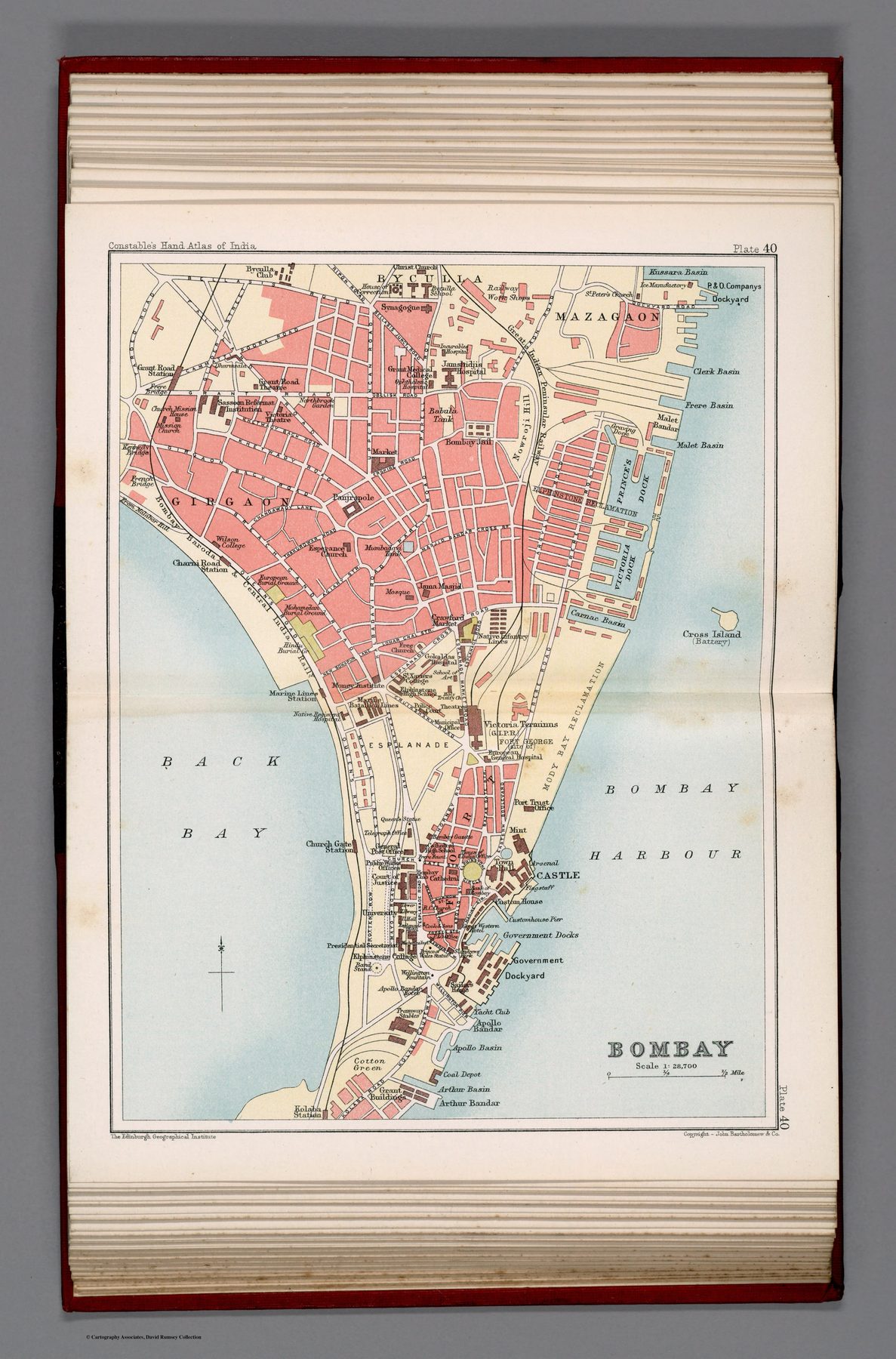
Bombay. Plate 40
The city plate
Plate 40 was prepared at the Edinburgh Geographical Institute under John George Bartholomew. At approximately 1:28,700, it is the closest-scale object in the Bombay room and complements the preceding map of the city’s wider environs.
Civic information
The plan identifies streets, blocks, parks, post and police facilities, public buildings and harbour-side infrastructure. Such detail is useful to the visitor, resident and administrator alike; the same sheet can orient movement and display institutions of government.
From island to city
Earlier maps in the room approach Bombay as anchorage or harbour. By 1893 the subject is a dense urban fabric whose internal divisions can be fixed and indexed. The map records the transformation of an island port into an imperial metropolis.
The gaze
The narrowing gaze reaches the street. Urban space is made manageable through the precise location of roads, blocks and civic institutions—the city held as an administrative diagram.