← Home Ground Bombay and Deccan
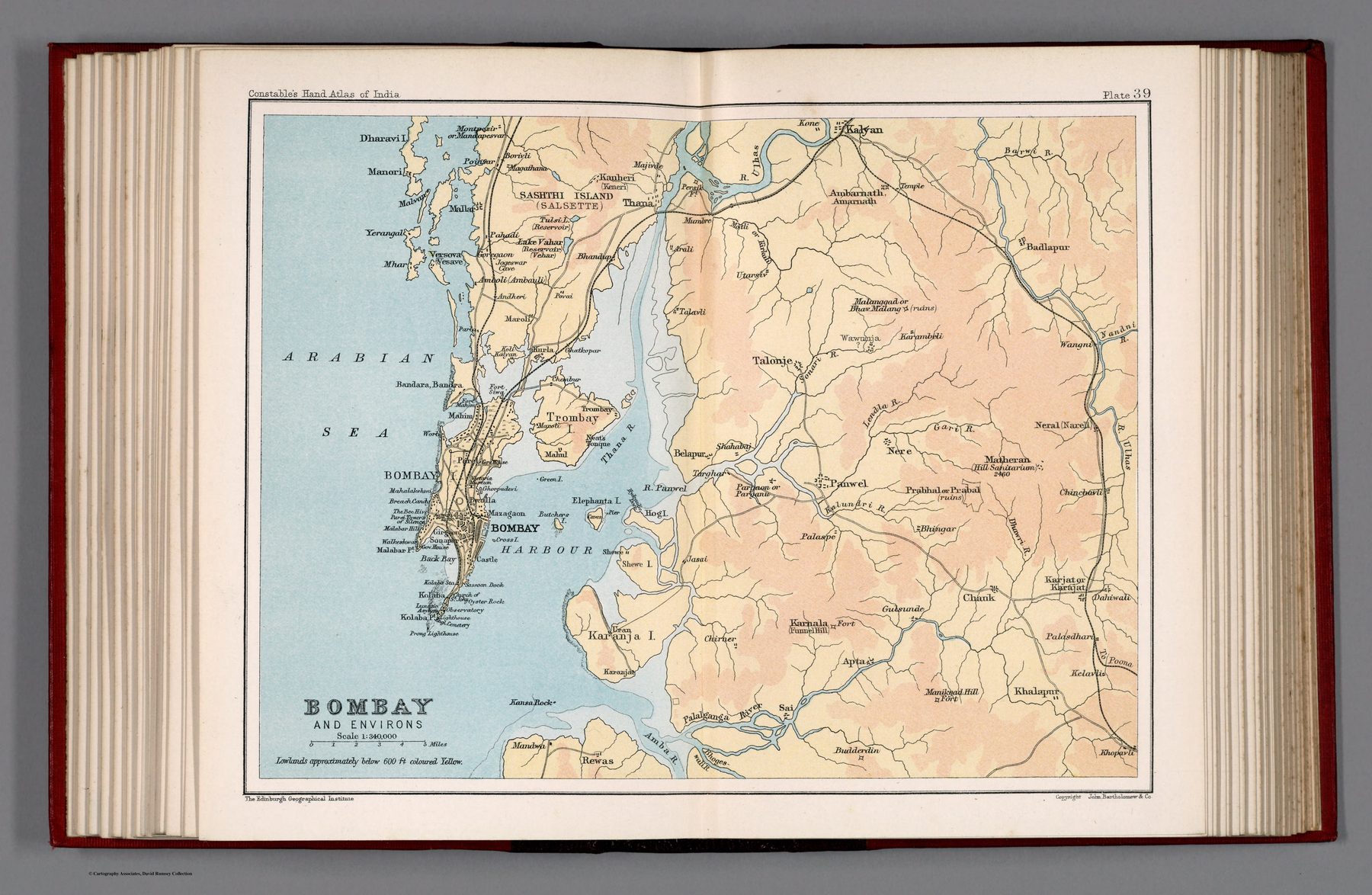
Bombay and Environs. Plate 39
The atlas plate
Plate 39 was prepared at the Edinburgh Geographical Institute under John George Bartholomew for Constable’s Hand Atlas of India (1893). The atlas drew upon official and other surveys but translated them into compact, commercially published reference plates.
City and hinterland
At approximately 1:340,000, the map links Bombay to the country around it. Roads, railways, settlements, coast and relief show the metropolis not as an isolated plan but as the hub of a regional transport and harbour system.
Layer-coloured relief
Elevation tinting makes physical setting analytically visible. The method belongs to Bartholomew’s modern cartographic style: colour is not chiefly ornament but a coded means of distinguishing height and terrain.
The gaze
Bombay is read as an imperial node—port, railway centre and metropolitan gateway—whose significance lies in the connections between city, harbour and hinterland.