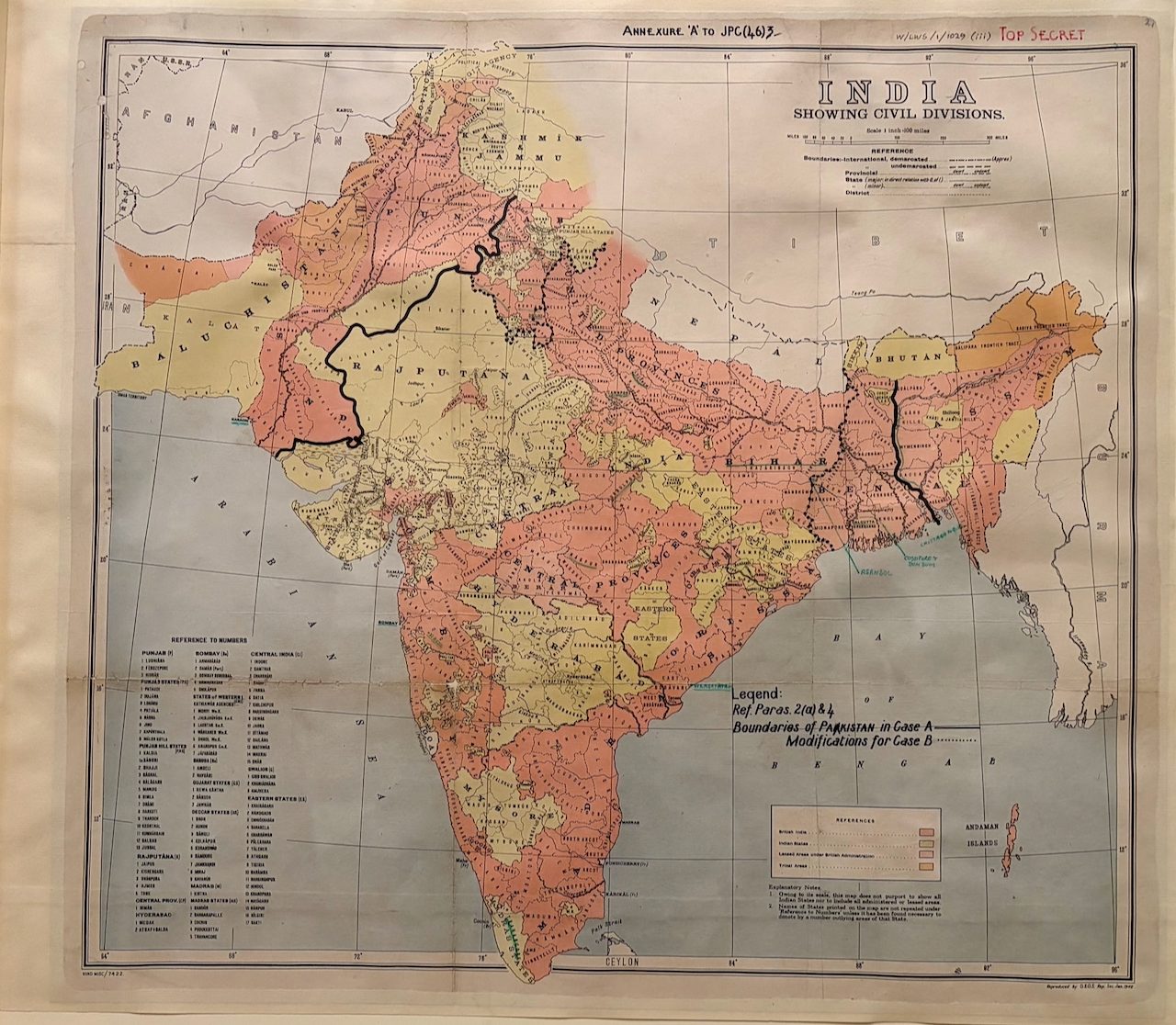
India Showing Civil Divisions — Boundaries of Pakistan (Case A / Case B)
A Top Secret British staff map from the planning that preceded Partition — a standard India Showing Civil Divisions base sheet overprinted with two proposed boundary schemes for a future Pakistan. These are alternatives under examination in 1946, not the Radcliffe boundary ultimately announced in August 1947.
Authorship and object
The base is a standard India Showing Civil Divisions sheet reproduced by the Geographical Section, General Staff (G.S.G.S.), the British War Office’s mapping body, at one inch to one hundred miles. It is overprinted as “Annexure ‘A’ to JPC(46)3” and stamped TOP SECRET. A heavy line marks the “Boundaries of Pakistan in Case A,” with a dotted line for “Modifications for Case B.” The sheet clearly belongs to classified official planning; without the accompanying paper, the full title and remit of the referenced committee should not be asserted more precisely.
A contingency, not yet a border
The map sets out alternative schemes for a possible Pakistan in the north-west and north-east. It is therefore evidence of options being examined, not a draft of the final Radcliffe line. The definitive Punjab and Bengal boundaries emerged from a different commission and were announced only after independence in August 1947.
The gaze
Few objects in the collection expose official cartography as decision-making so directly. Provinces and populations are placed within alternative cases, and a coloured line becomes an instrument through which defence, administration and political settlement can be imagined. This exercise did not itself become the final border, but it belonged to the boundary-making process over which the departing power presided — a process whose compressed timetable and consequences would be borne on the ground by millions.
Provenance note
The interpretation above is confined to markings visible on the supplied sheet and to the distinction between these 1946 planning alternatives and the later Radcliffe Award. A permanent archival catalogue reference for this particular copy has not yet been identified and should be added when verified.