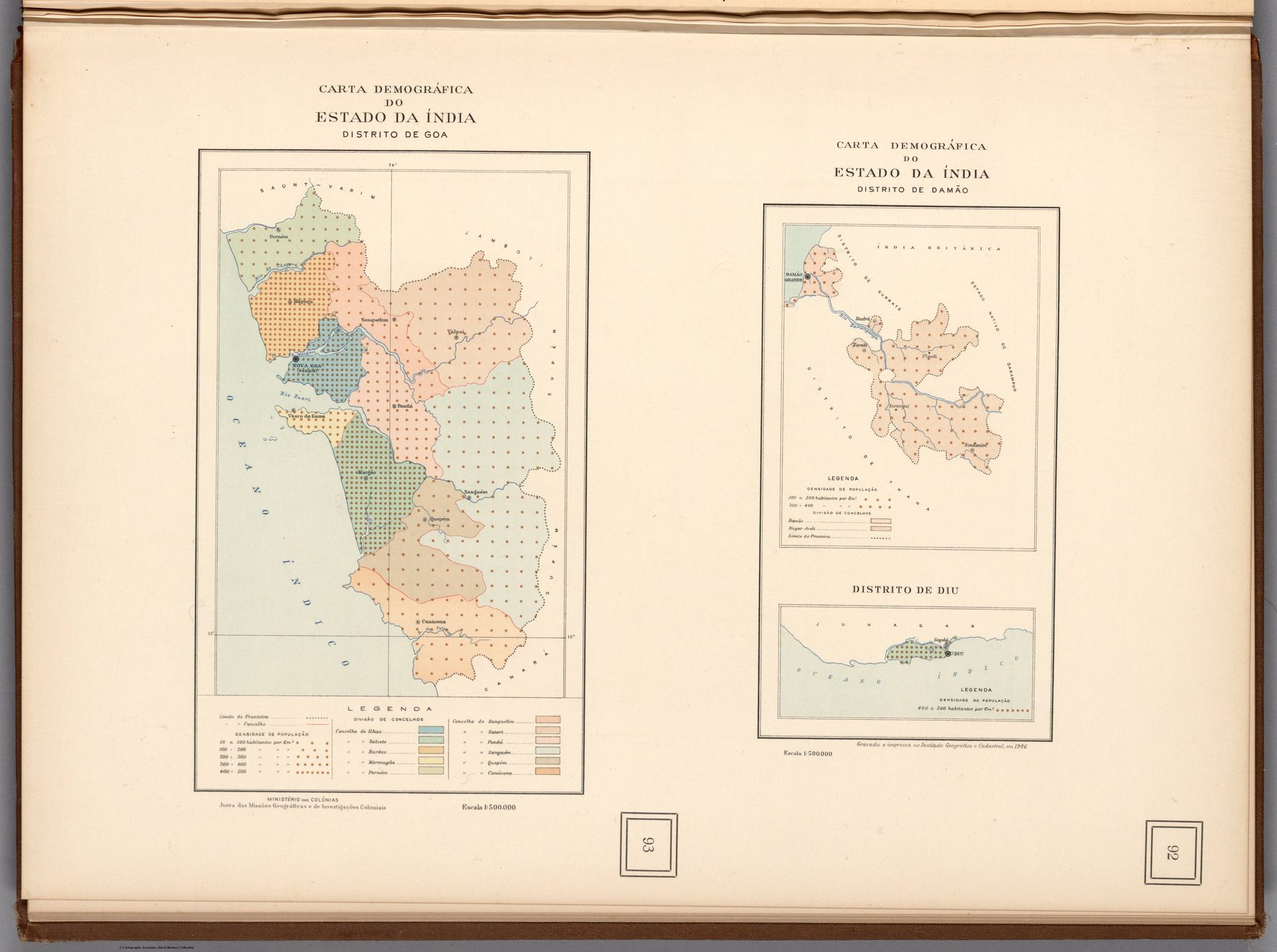
Carta demográfica do Estado da Índia — Goa, Damão and Diu
Three demographic maps of Goa, Daman and Diu — the remaining Portuguese enclaves in India — engraved in 1946 and published in the 1948 Atlas de Portugal Ultramarino. The four-century European sequence closes where it began, with Portugal, its once-vast claim reduced to a few administered coastal territories.
Authorship and object
The sheet was produced for Portugal’s Ministério das Colónias and Junta de Investigações Coloniais and engraved and printed at the Instituto Geográfico e Cadastral in Lisbon in 1946. It was published in 1948 in the Atlas de Portugal Ultramarino e das Grandes Viagens Portuguesas de Descobrimento e Expansão. The three maps show Goa, Damão and Diu through population, boundaries, settlements, water and physical features; the Rumsey record notes that the individual scales differ, with the principal statement approximately 1:500,000.
The colonial state’s self-portrait
The atlas was an intellectual production of the Portuguese colonial research apparatus — a systematic portrait of “overseas Portugal” that joined modern demographic and administrative mapping to a commemorative narrative of discovery and expansion. These sheets apply the census-and-boundary logic of the twentieth-century state to the surviving fragments of Portuguese India.
The gaze
The closing symmetry is unusually exact. The collection opens in 1519 with a Portuguese royal atlas imagining command of the Indian Ocean; it reaches 1946 with the Portuguese state tabulating what remained — Goa, Daman and Diu. India would become independent the following year, while Portuguese rule in the enclaves continued until 1961. The imperial field has contracted from an ocean to three small territories, but the administrative eye remains confident to the end.
Source and image
David Rumsey Historical Map Collection, List No. 14369.095: catalogue record and zoomable image.