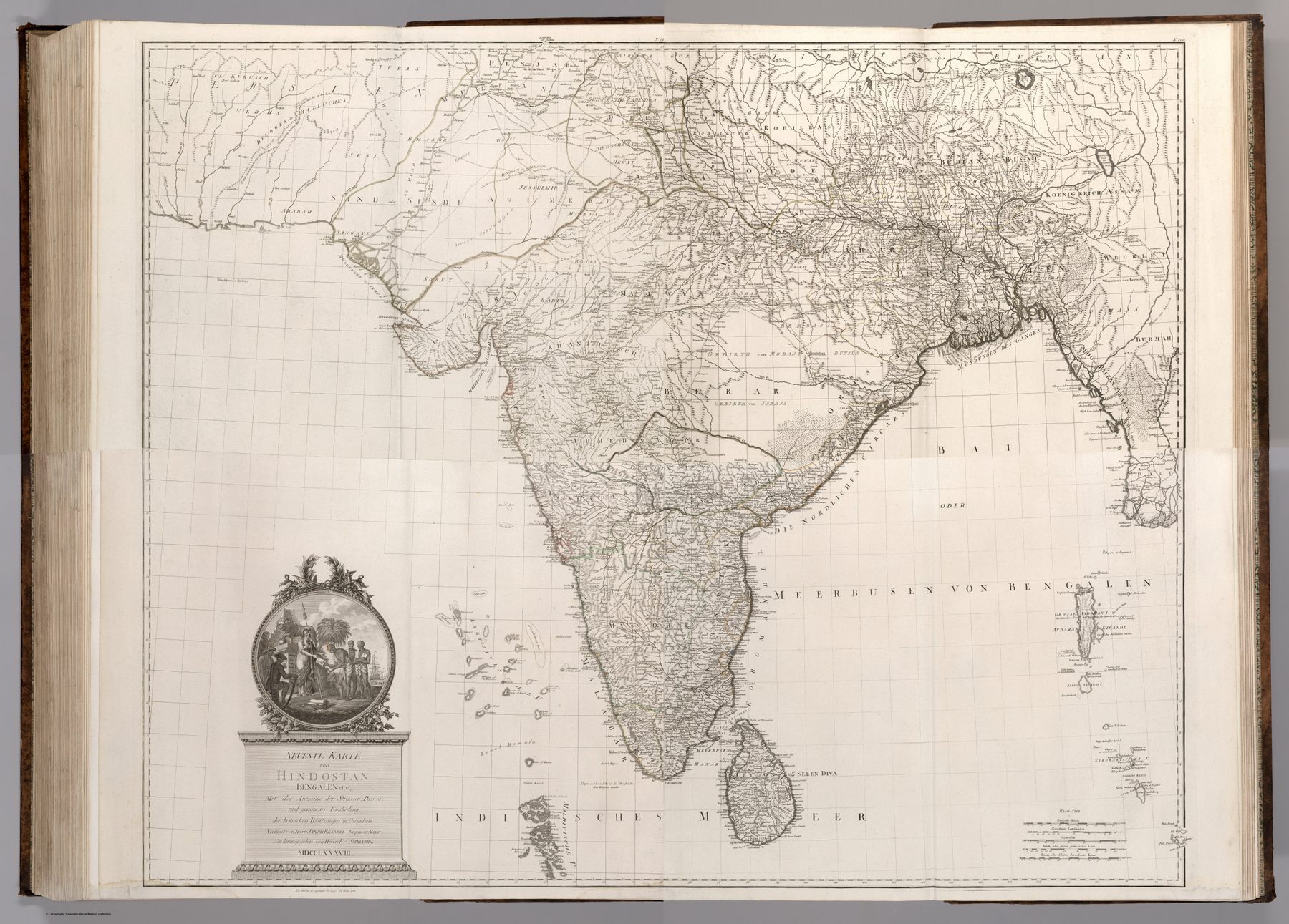
Neueste Karte von Hindostan und Bengalen
Rennell translated into Vienna
Franz Anton Schrämbl issued this four-sheet map for his Allgemeiner Grosser Atlas, the first major commercial atlas produced in Austria. Its title advertises roads, passes and the detailed division of British possessions in the East Indies, and expressly names ‘Jakob Rennell’ as its authority.
Plate date and atlas date
The map bears the date 1788, while Schrämbl’s immense atlas was completed and published as a whole in 1800. That interval is not a contradiction: the project appeared in parts over many years. The plate therefore records both the rapid reception of Rennell and the slower manufacture of a monumental atlas.
Copying as circulation
This is not a derivative of little interest. Re-engraving translated British Company knowledge into German, enlarged it for a Central European audience and detached it from the institutional setting in which the surveys were made. What began as strategically privileged information became a commodity in the international atlas market.
The gaze
Rennell’s measured India is here naturalised as simply the newest and best India. The map shows how imperial survey acquired authority beyond the empire that produced it: Europe learned to see the subcontinent through British routes, divisions and territorial categories.