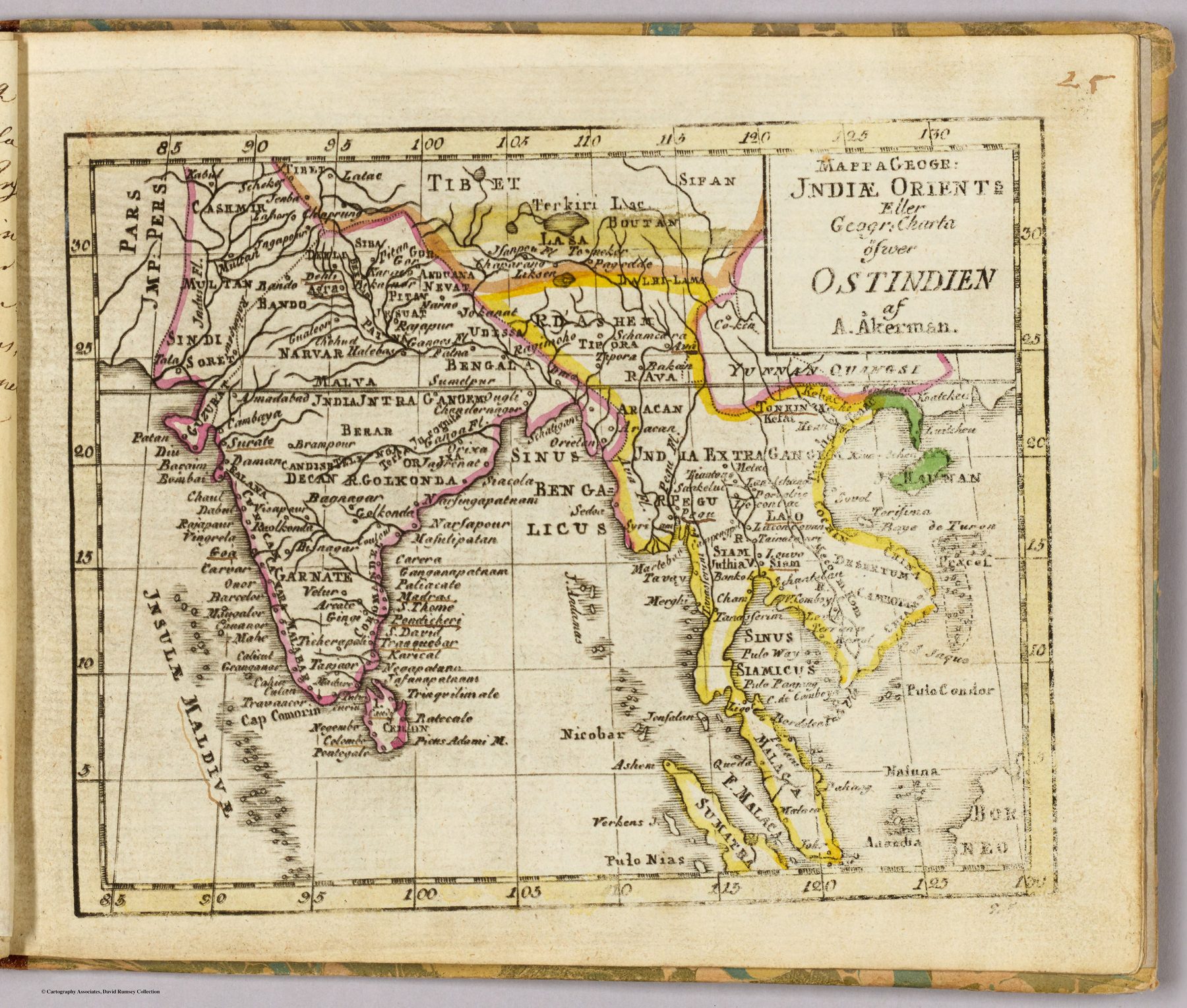
Mappa geogr. Indiæ Orientalis
An atlas ‘for the service of youth’
Åkerman, an engraver and globe-maker associated with the Royal Society of Sciences at Uppsala, designed the Atlas juvenilis as a methodical geographical course. This map belongs to the expanded second edition issued after his death. Its compact format, selective labelling and accompanying annotated text were intended for instruction rather than specialist reference.
Reduction and authority
At a scale of roughly 1:50,000,000, India and the wider East Indies must be simplified drastically. The map does not display the density of Rennell or Faden; its significance lies in what it assumes. A standard European outline and nomenclature can now be compressed without explanation because the larger cartographic consensus already exists behind it.
The gaze
India has entered the curriculum. Knowledge first guarded by pilots, companies and survey offices is converted into elementary geography for Swedish pupils. The distant subcontinent becomes one lesson in an ordered world, its complexity exchanged for the clarity required by a school atlas.