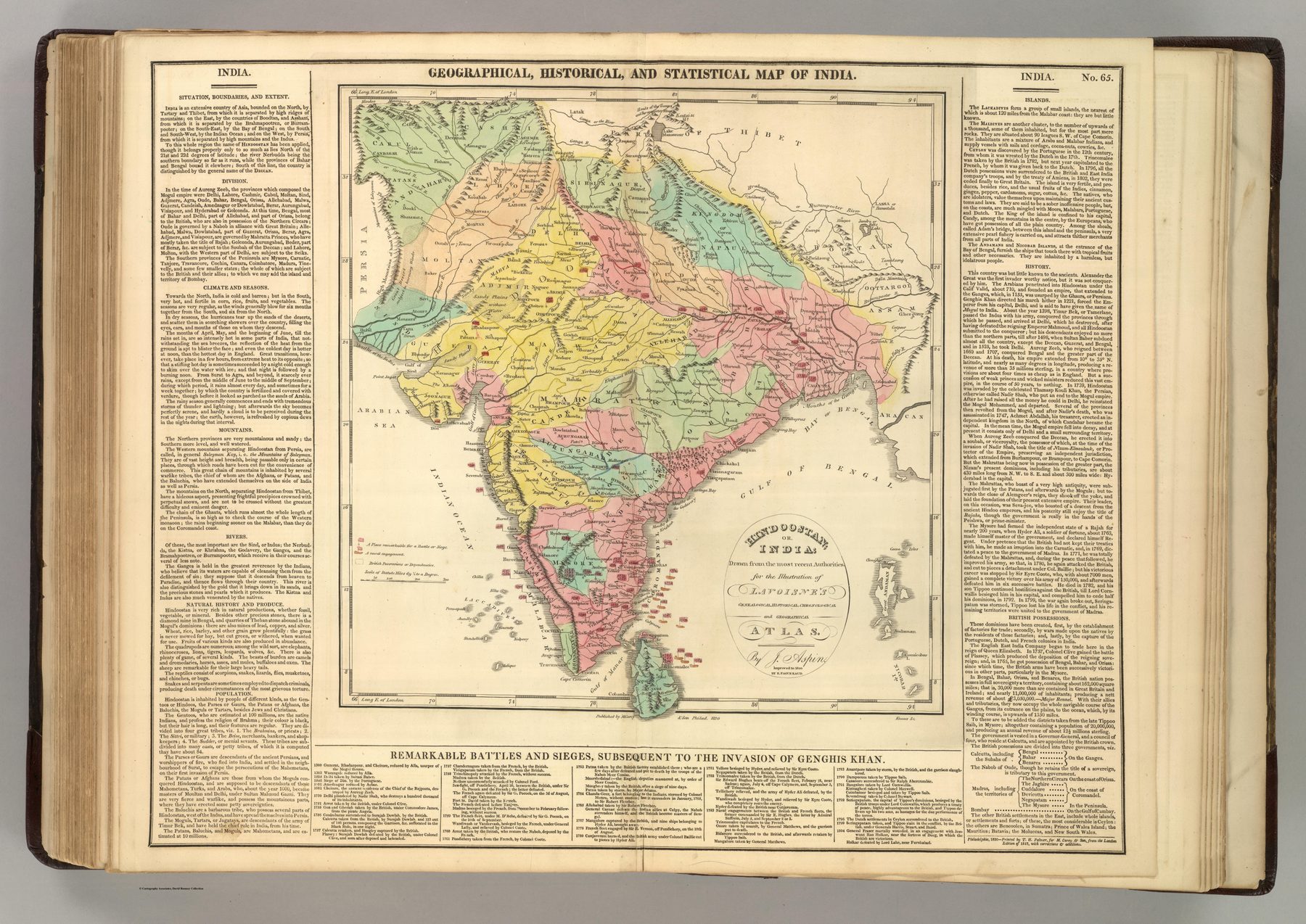
Geographical, Historical, and Statistical Map of India
A map inside a historical system
This plate appeared in the first American edition of Lavoisne’s Genealogical, Historical, Chronological, and Geographical Atlas, published by M. Carey & Son in 1820 after the London edition of 1817. The map was drawn after J. Aspin and engraved by Kneass; T. H. Palmer printed the volume.
Geography, chronology and war
The central map is only one component. Tables and prose arrange Indian history into rulers, dates, battles, sieges and statistical facts, while small flags key episodes of warfare to particular places. The form promises that territory and history can be comprehended together at a glance.
Across the Atlantic
This is neither Company cartography nor a map for Indian administration. It is British imperial history repackaged for an American educational market. The subcontinent becomes one panel in a universal chronology, and conquest is converted from lived violence into ordered information.
The gaze
The historical atlas makes empire teachable. It does not conceal conflict, but its tabular form disciplines it: wars become entries, territories become colour fields and the expansion of British power becomes a sequence that appears intelligible and complete.