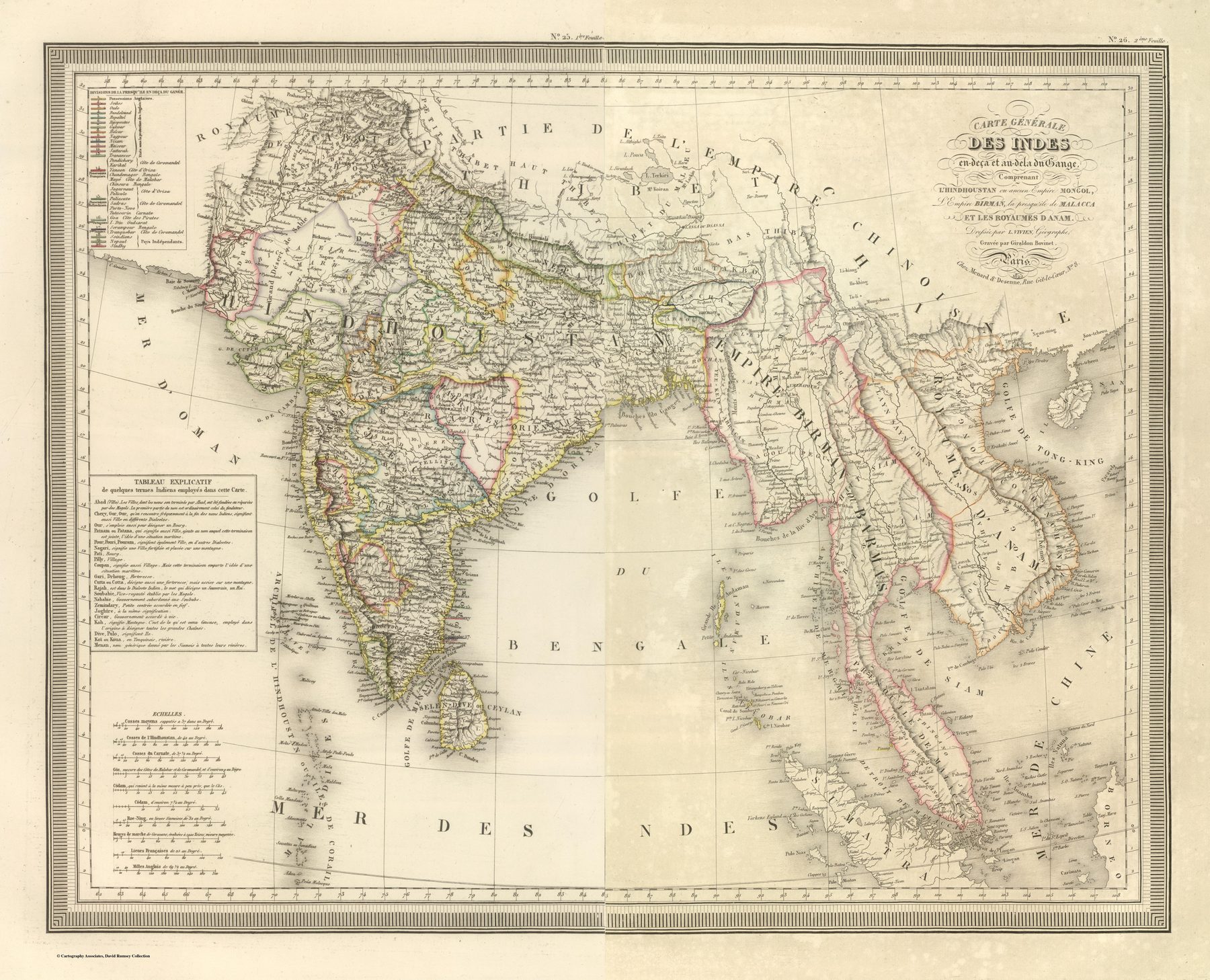
Carte Générale des Indes
Two sheets, one learned geography
The map was engraved by Giraldon-Bovinet in two sheets, each dated 1825, and appeared in Vivien’s Atlas Universel of 1827. The composite extends from the Indian subcontinent through Burma, the Malay Peninsula and the kingdoms of Annam, combining hachured relief and outline colour at about 1:9,500,000.
Old categories, new information
The full title retains ‘the Indies on this side and beyond the Ganges’ and describes Hindoustan as the former Mughal Empire. These inherited categories coexist with a substantially updated geography. The map is not simply antiquated; it demonstrates how conceptual frames can survive while the detail within them changes.
A parallel French tradition
British survey dominated the production of new territorial knowledge in India, but it did not monopolise its interpretation. Vivien reorganised available information within a French academic atlas intended to serve both ancient and modern history.
The gaze
India remains part of a larger ‘Indies’ comprehended from Paris. The perspective is learned and continental rather than directly administrative: British measurements are absorbed into a geography whose organising language still reaches back through the French school to Ptolemy.