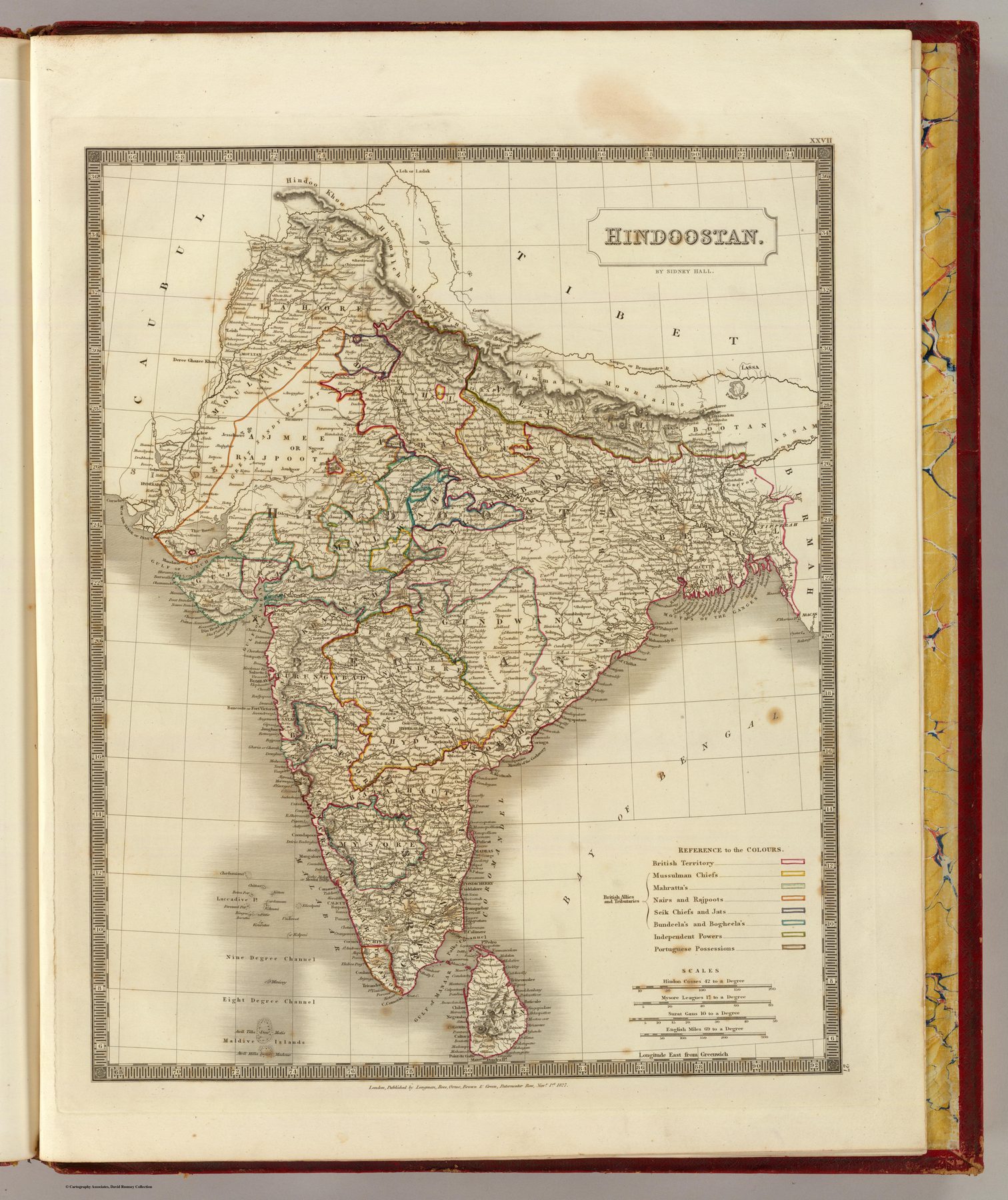
Hindoostan
A plate issued before its title page
Hall’s map bears the date 1 November 1827, while the first edition of the atlas is dated 1830. The maps were produced and apparently issued in parts before the completed volumes received their title page. Outline colour and hachured relief give the sheet the clarity and restraint associated with early nineteenth-century British commercial engraving.
Survey assumed rather than displayed
Unlike Rennell’s maps, Hall’s plate does not foreground the process of measurement. It inherits a cartographic framework already transformed by decades of route surveys and compilation. The labour of survey has receded into the apparently self-evident accuracy of the atlas.
A divided political landscape
The map should not be read as a simple picture of an already ‘settled dominion’. In 1827 the subcontinent remained a complex field of Company territories, princely states and neighbouring powers. What is settled is the cartographic confidence with which that political variety is bounded and named.
The gaze
India has become ordinary reference knowledge for a British middle-class readership. The map’s authority lies partly in its plainness: the surveyed and politically classified subcontinent appears less as an argument than as a fact.